
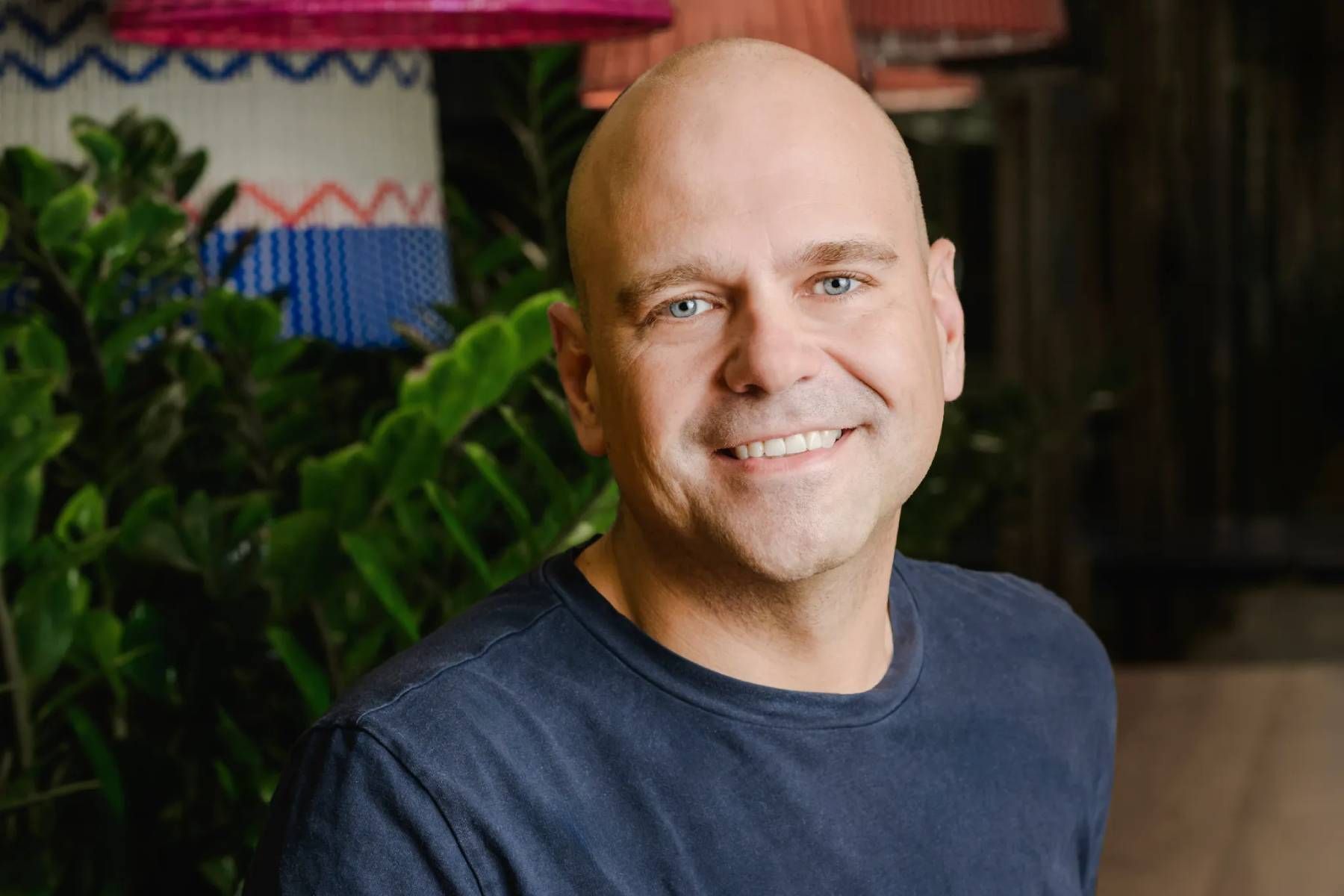
The air is a sticky 34 degrees in North Queensland as Dawid Naude hauls a stray crocodile out of a pond.
It’s not the usual way to spend the hours between university lectures. But years later, trapped in a corporate loop of strategy slide decks and endless meetings, Dawid thought fondly of those moments.
So he walked away from the safest career of his life to build Pathfindr, a startup to teach organisations how to do their best work with artificial intelligence.
A future set by family
When Dawid was a kid in South Africa, a computer arrived at the family home.
It had a monitor as thick as a bar fridge and ropes of cable spilling from the back. Many parents would have guarded it like a museum artefact.
“You can play with it, go your hardest, do whatever you want,” Dawid’s mother said to him. “And if you break it, we’ll get it fixed.”
So he did. He changed settings, unscrewed the case, pulled the hardware apart and, on occasion, even managed to put it back together.
“I had great curiosity and experimentation,” he says.
At Rhodes University, where he enrolled in computer science, he took more interest in running his residence's pub than in his degree. By second year, his marks were slipping and the writing was on the wall.
So he restarted his life on the other side of the Indian Ocean.
His father had recently walked out on a career in finance, moved to North Queensland, and sunk his savings into a prawn farm an hour north of Townsville.
Dawid enrolled at nearby James Cook University to study e-commerce and information systems. Between classes, he worked beside his father on the farm.
“It’s 95% humidity and you're in salt water all day,” he says. “It was hectic, hardcore, brutal work.”
After surviving university, Dawid had two paths in front of him. One was a technology role with KPMG's IT advisory team. The other was a job at NAB, where his father's banker could make an introduction. Dawid chose the bank.
“It came out of an insecurity of grabbing the thing that’s in front of you,” he says.
Dawid started as a banker, moved to financial markets, and passed the first level of the Chartered Financial Analyst program with a gruelling six-hour exam that 80 per cent of candidates fail.
By his late twenties, he was crowned an Associate Director. Yet within a week, the title had lost its shine.
“Is this it?” he recalls.
Starting over
Dawid started job hunting. A friend from South Africa put in a word for him at Accenture, and nine months later he landed a junior technology consulting role.
He packed up for Sydney with his partner, walked away from a six-figure bonus, and took a 50 per cent pay cut to start again at the bottom.
At Accenture, he fell into the world of customer relationship management software. It helped that he had used Salesforce from the other side of the desk at NAB.
In his first six months, he was labelled a high achiever and received a global award.
“If you knew enough about the technology and the problem that you were trying to solve, you were very, very powerful,” he says.
Less than a year in, startup Cloud Sherpas called him on a Wednesday looking for Salesforce talent. He went for coffee on the Thursday and had an offer by Friday.
He spent the startup's boom years working across cloud and early artificial intelligence, until Accenture acquired the company in 2015, absorbing him back into the mothership at a much higher level.
Over the next eight years at Accenture, Dawid rose to managing director across AI, innovation and platforms. But the more senior he became, the more his days disappeared into meetings.
“Turning up to a meeting because it would be noticed if I’m not there,” he says, “that is not a good reason to be at a meeting.”
He had escaped finance only to find himself back in the same corporate trap.
“I was getting anxious. I was getting very depressed,” he says. “I couldn’t do the rest of my life like this.”
Christmas with AI
Over a Christmas break in the early days of ChatGPT, Dawid started poking at an old enterprise headache.
The client had a codebase that was 30 or 40 years old. It was written in Delphi Pascal, a programming language Dawid hadn’t heard since high school.
Two engineers had spent three decades maintaining it, and they were the only people alive who understood it.
The plan was to lock four people in a room for a year to read the ancient code line-by-line, document it, then figure out how to move away from it. It was work no one on the planet ever dreamed of doing.
Dawid took the code and fed it securely into a large language model. He told it a bit about the problem, what the code was trying to address, and asked what it could do. It spat out an answer in seconds.
“All of a sudden I realised this tool could probably make it a one-person project and take three to four weeks,” he says. “I just loved it; I thought it was fascinating.”
The gap is the business
Soon after, Dawid sat alone at a small table in a Melbourne café. A blank notepad lay beside his coffee.
He picked up his pen and wrote ‘Customers’ on the left side of the page, and ‘Wins with AI’ on the right.
In the empty middle he started jotting down the obstacles that stood in the way of a company adopting AI.
“I ended up squiggling all these lines between them, going: ‘this whole field is going to need so much help to navigate,’” he says.
Dawid went home and opened a spreadsheet. He tallied his savings, added his long service leave, and counted exactly how many months his family could eat without an income.
On 16 January 2024, Dawid left corporate life behind and launched Pathfindr.
The $500,000 deck nobody can find
"There is so much opportunity out there," Dawid says. "So many companies have money they want to spend to solve their problems."
But Dawid had seen where that money often went: half a million dollars into a strategy deck that changed nothing on the ground for the people who commissioned it.
“In the most extreme cases, they can’t find the PowerPoint,” Dawid says. “They say, ‘I think it’s in this person’s inbox. I think it’s in the SharePoint folder.’”
Part of the problem, he believes, is where organisations put the responsibility.
AI usually lands on the desk of the Chief Information Officer, whose job is to make technology secure, compliant and scalable – not to redesign how a call centre handles their weekend complaint backlog on a Monday morning.
That kind of work belongs to the leaders closest to the problem. But those leaders often do not know how to use the tools themselves.
“Everything in a company flows from the decisions leadership makes,” Dawid says.
While many had experimented with AI to rewrite an email or summarise a document, beyond that, they were stuck.
“They’re really worried,” Dawid says. “Imagine how productive Microsoft Word would be for you if you were concerned every time you used it, it was going to spill your information onto the internet.”
Power users over PowerPoint
Rather than sell companies an AI strategy, Pathfindr teaches leadership teams to use AI well enough to build their own systems.
"Don't ask me how you can use AI in the call centre," Dawid says. "I'm going to show you how to use AI to figure out how you can use AI in the call centre.”
For example, take a health insurance company. The graphic designer creates a tile for an Instagram post to promote a new member offer.
Before it can go live, it goes to legal for review. There it sits in an inbox, comes back with comments, gets updated, goes back again, and waits. A post that took minutes to design can spend days in approval.
So Pathfindr shows the legal team how to build its rules into an AI agent instead.
The designer uploads the image, the agent checks it for compliance, and flags any problems in seconds. With just an afternoon’s work, the designer never has to chase legal again.
“We teach leadership teams to become power users of AI,” Dawid says.
Customers won’t come to you
Pathfindr’s first home was StartSpace at the State Library of Victoria.
Before long, Dawid was eyeing off Stone & Chalk Melbourne.
“I needed space for my team to do a couple of days a week,” Dawid says. “Stone & Chalk was flexible in providing a structure that suited us.”
By late February 2024, barely six weeks in, the list of customers was still thin and the bank balance was weeks from zero.
“I said to Graham [at Stone & Chalk]: ‘I’m getting worried about needing to wind this up,’” Dawid confessed.
While Dawid saw the market for training was there, Pathfindr was a new company trying to sell AI advice against global firms, including Accenture, with billions to flood the market with people, courses and brand recognition.
"People who aren't entrepreneurs say to you, 'I guess customers come to you,'" he says. "Customers don't come to me for jack."
So Dawid fired off cold emails and arrived early to conferences, hovering near the coffee urn hoping to snare the right person for sixty seconds.
He hated every minute of it.
"Either I'm on the stage or I’m nowhere near that conference," he says.
When you have five potential customers and can afford to lose none of them, you negotiate from fear. You slash your price, take poor-fit work, and say yes to clients you already know will hurt.
"The painful customers usually pay the least and expect the most," Dawid says.
An engine to find customers
Dawid was mid-set at the gym, headphones in, thumbing through Spotify, when he tapped on a Diary of a CEO episode with entrepreneur Daniel Priestley.
“He had this one sentence: ‘Everything in your business is a reflection of your ability to generate leads,’” Dawid recalls. “And I thought, man, that is so true.”
If he had fifty clients banging on the door, and he could only say yes to five, the power changes. He could set higher prices and hire the best team.
Better still, he could walk away from bad clients and focus entirely on doing great work for the good ones.
"The quality of the service you deliver, even the people you hire, they're all a reflection of how many people want to work with you," he says.
Dawid stopped trying to hustle his way into rooms and started trying to become known to the right people. He wrote on LinkedIn, pushed out content, and ran a webinar every second Wednesday.
“You don't need to be Kanye West or a Kardashian," Dawid says. "What you want is to be a little bit more famous in your niche with the customers that actually want to buy from you.”
At first, the webinars were tiny. Sometimes one person showed up, but Dawid presented as if the room were full. Each fortnight he'd tweak one variable.
Attendance, he noticed, almost didn't matter. People who never registered would reach out after the third or fourth webinar drifted through their LinkedIn feed.
“People say customers buy on value,” he says. “That’s not true. They buy on trust.”
Once someone was curious, Dawid did not want to slow them in the usual maze of sales calls and proposals. So he built an AI readiness assessment they could complete in the five minutes they had free between meetings.
“A major enterprise contacted us and said: ‘We took your AI readiness assessment and scored 32% and thought we should call you,’” Dawid says.
Each morning, he’d open his inbox, and see more and more people, all potential customers, asking for his help.
When it rains, it pours
In just over a year, Pathfindr ran hundreds of masterclasses and trained more than 10,000 people, with clients including Coles, Woolworths, Virgin Australia, the ABC and the Victorian Government.
The growth caught the attention of Affinda Group, a Melbourne company with its own suite of AI products and customers around the world.
At first, the conversation was about capital. One part of Affinda’s business helps founders raise money, and Dawid was ready to explore that path for Pathfindr.
But as the two companies got to know each other, a bigger opportunity emerged.
“They were great at raising capital and building products,” Dawid says. “But the two co-founders didn’t see themselves as great on stage.”
Dawid could see the gap on Pathfindr’s side too. If his company wanted to build its own AI products, it would need more money and a stronger technical team.
In October 2025, Affinda acquired Pathfindr in a $15 million all-stock deal. Dawid and his team joined Affinda, giving Pathfindr the money, engineers and support it needed to keep growing.
Dawid describes it as a chance to “have your cake and eat it too.”
What he tells founders now
Dawid practises Brazilian Jiu-Jitsu. In class, an instructor breaks down a new submission: where the hand goes, how the hips turn, when the pressure is applied. Dawid drills it for an hour, step-by-step.
Next session, he's sparring. The first few times he tries the move against a resisting partner, the grip slips and he can’t get the timing right.
But after enough live rounds, his body starts to remember what his mind no longer has time to process. He locks in the submission, and his partner taps out.
Dawid applies the same principle to sales calls.
Understanding the pitch isn't enough, and neither is rehearsing it in front of a mirror. A pitch only becomes reliable after it has survived contact with customers enough times that you no longer have to think about it.
“Your earliest pitches are going to suck,” he adds. “The first time you do a discovery call or a proposal call, just always keep in mind it’s the worst one you’ll ever do.”
He points to a commencement speech given by Roger Federer at Dartmouth College. Federer won almost 80 per cent of the singles matches he played over his career, but only 54 per cent of the points.
“The greatest tennis player loses almost half of his points,” Dawid says. “You very quickly tell yourself, ‘it’s just another point.’”
Back in the prawn pond
When you're hip-deep in a prawn pond with a crocodile, no strategy deck can save you.
AI, Dawid believes, is no different. You can't buy your way to understanding it, and you can't delegate it down the hall.
You just have to get your hands dirty, grab a hold of it, and pick it up yourself.
