
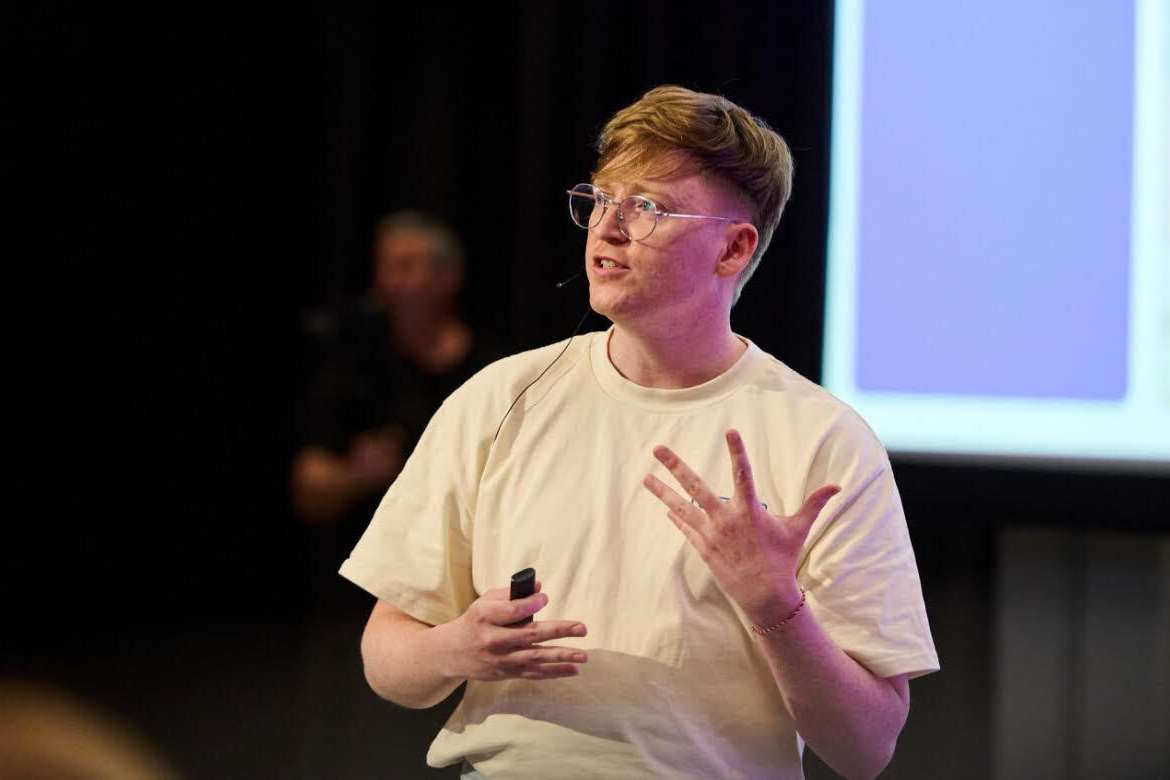
"What I learnt from startups was that if you want to fix something, you can just build it. You don't need to wait for permission," says Sam Donegan, President of MLAI.
Australia has no shortage of smart people. But according to Sam, one of the country's biggest challenges is turning that talent into globally successful technology companies.
MLAI, the volunteer-run not-for-profit, whose name stands for Machine Learning and Artificial Intelligence, is on a mission to help create more Australian startups in artificial intelligence and other high-growth technology sectors.
Through hackathons, workshops, networking events and startup education programs, MLAI connects aspiring founders, engineers, students and investors with the skills and community they need to turn ideas into companies.
Since launching, the organisation has helped support the creation of more than 70 startups and built a community of thousands of people interested in entrepreneurship and emerging technologies.
For Sam, however, the journey began in a very different world.
From medicine to startups
Seven years ago, Sam was working as a doctor.
Like many medical professionals, his career followed a structured path. There were established processes, clear expectations and defined ways of doing things.
But after several years working in hospitals, he found himself becoming increasingly curious about a different way of solving problems.
Around the same time, he became involved in building a health technology startup. What began as a side project quickly turned into something much bigger.
"I always thought I'd go back to medicine," says Sam. "But I got sucked into the startup world and never really left."
What appealed to him wasn't just the technology, it was the freedom.
In medicine, changing a process often meant navigating layers of policy, procedures and approvals. In the startup world, ideas could be tested quickly.
"If you want to solve a problem, you can just start building something," he says. "That was a pretty earth-shattering realisation for me."
The experience opened his eyes to entrepreneurship as a way of creating change.
Rather than working within an existing system, founders had the opportunity to build entirely new solutions.
The healthtech company would eventually be acquired, but by then Sam had already discovered something that would shape the next chapter of his career - his passion for startups.
Finding a community
Sam's introduction to MLAI came through one of the organisation's early events.
He remembers the experience vividly.
Surrounded by smart, ambitious people working together to solve difficult problems, he found the atmosphere energising.
"There was this weird kind of magic," he says. "You had people working really hard on something they cared about, surrounded by other people they respected. Everything felt new and exciting."
The experience reminded him of what had drawn him to startups in the first place – the creativity, the experimentation and the possibility that a simple idea could become something meaningful.
When the opportunity arose to become more involved, he jumped at it.
What started as volunteering gradually turned into increasing responsibility until eventually, he became president of the organisation.
Today, MLAI remains largely volunteer-run, powered by a community of people who share a belief that Australia can produce more world-class technology companies.
Building a stronger innovation economy
At the heart of MLAI's mission is a belief that Australia can do more than export raw materials.
Sam often describes Australia as "the lucky country". For decades, the nation's wealth has been supported by industries such as mining and resources.
While those sectors remain important, Sam believes Australia also needs to invest in industries that create more complex products, technologies and intellectual property.
"We've got incredibly smart people here," he says. "The question is how we help more of them turn their ideas into successful companies."
That's where MLAI sees its role. The organisation aims to help launch 1,000 Australian startups by 2030.
To achieve that goal, it focuses on three key areas.
First, it creates accessible events that introduce people to entrepreneurship and artificial intelligence in a fun, low-pressure environment.
Second, it helps founders develop practical startup skills, from building products to finding customers and raising investment.
Third, it connects people. In many cases, the difference between an idea staying on a whiteboard and becoming a company is simply meeting the right collaborators.
"We teach people how to build startups, how to build with AI, and how to find the people they need to make it happen," says Sam.
Why AI changes everything
Sam believes there has never been a better time to start a company.
The rise of artificial intelligence is dramatically lowering the barriers to building products and launching businesses.
Tasks that once required teams of specialists can increasingly be completed by individuals equipped with the right tools.
As a result, founders can move faster and test ideas more cheaply than ever before.
"It's becoming easier and easier to turn an idea into something real," he says.
For aspiring entrepreneurs, that's creating opportunities that simply didn't exist a few years ago.
Rather than spending months learning technical skills or searching for expertise, founders can now access powerful tools that help them build, prototype and validate ideas much more quickly.
Sam believes this shift will unlock a new wave of Australian innovation. "If you've got an idea, now is probably the best time in history to try building it," he reiterates.
Supporting Australia's AI ecosystem
While Sam is optimistic about Australia's future, he acknowledges there are challenges.
Compared with larger markets such as the United States, Australia has fewer investors, fewer major technology companies, and less access to the world's leading AI organisations.
Geography also creates obstacles. Many of the industry's biggest conferences, investors and technology leaders are located overseas.
Yet despite those limitations, Sam believes Australia's startup ecosystem is stronger than many people realise.
The country continues to produce innovative companies with global ambitions, while communities such as MLAI are helping connect founders, engineers and investors in ways that were far more difficult a decade ago.
"We've got a lot of very smart people in Australia," he says. "The opportunity is making sure they have the support they need."
Growing with a values-aligned community
As MLAI expanded, finding a home that aligned with its mission became increasingly important.
That home is Stone & Chalk.
As a not-for-profit organisation itself, Stone & Chalk provides a community and a space where early-stage founders can connect, collaborate and learn from one another.
"We probably couldn't exist in the same way without Stone & Chalk," says Sam.
The partnership allows MLAI to run events, bring people together and create opportunities for aspiring founders while remaining focused on its mission.
For Sam, the relationship works because both organisations share similar goals.
"We're both trying to help more Australian startups succeed," he says. "It feels very values aligned."
The space has also become a natural meeting point for entrepreneurs, students, investors and startup teams.
Some arrive with fully formed businesses. Others arrive with little more than an idea, but all are looking for opportunities to learn and grow.
Creating the next generation of founders
Looking ahead, Sam sees enormous potential for Australia's startup ecosystem.
The rise of artificial intelligence is creating opportunities that would have been difficult to imagine only a few years ago.
New companies can be built faster, and products can reach global markets more quickly. Small teams can now achieve things that once required entire organisations.
For Sam, the goal remains to help more people take the first step.
Whether that's attending an event, meeting a future co-founder or testing an idea for the first time, every successful startup begins somewhere.
If MLAI can help more Australians make that leap, the impact could extend far beyond individual companies. It could help create a stronger, more innovative and more resilient economy for the future.
"We've got the talent," says Sam. "Now it's about helping people believe they can build something with it."
