
On a cold June afternoon, a Falcon 9 rocket rose from California’s Vandenberg Space Force Base and disappeared into the clouds.
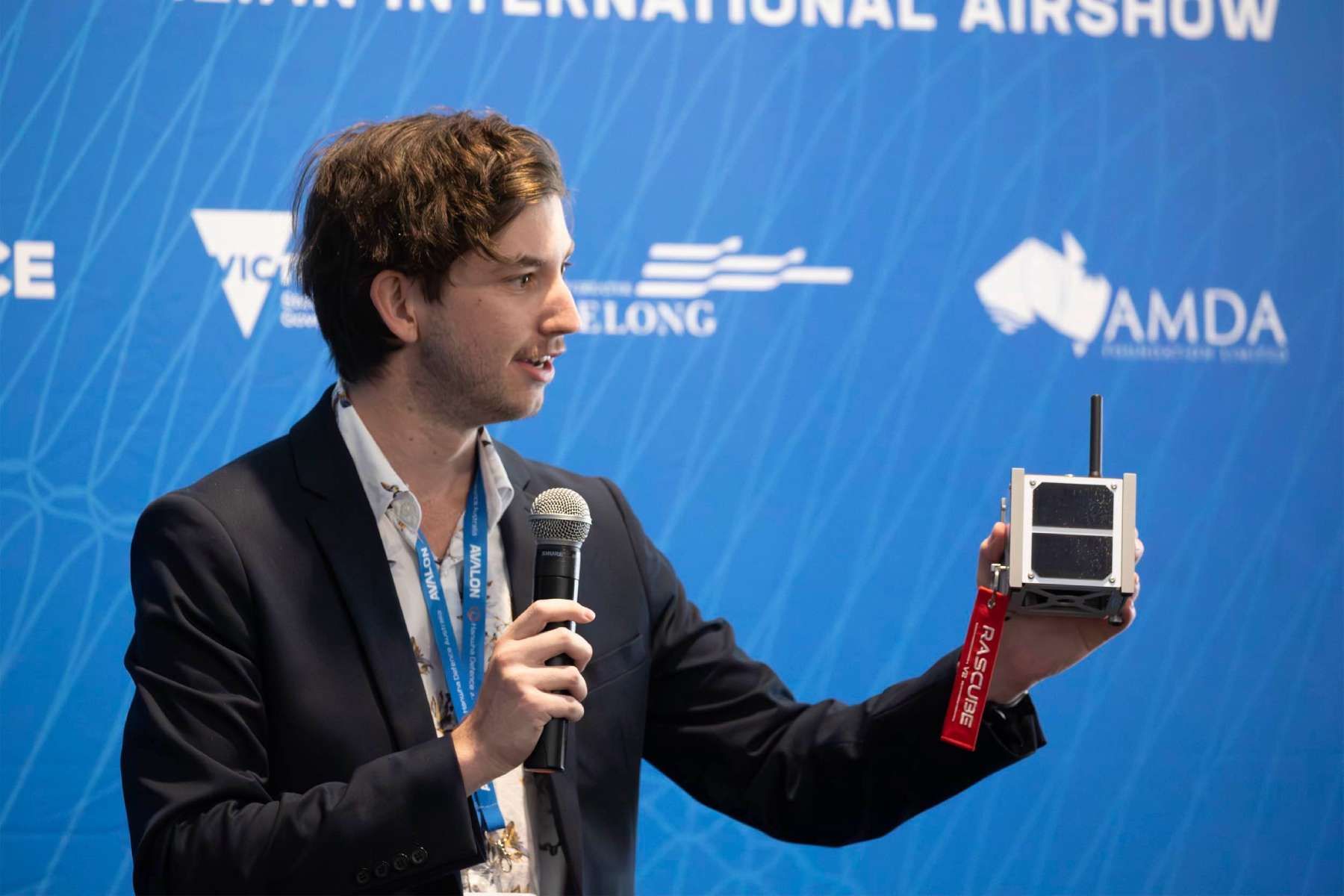
Strapped inside its nose cone was RASCube-1, a metal cube barely 10 centimetres wide. It was built by Robinson Aerospace Systems – the company Edward Robinson founded in South Australia’s Barossa Valley while still a teenager.
Edward had designed the RASCube as a classroom kit for teaching electronics, coding and physics. This version, however, was sealed inside an experimental space capsule and hurtling towards orbit.
If it survived the shaking and force of launch, the same technology students used at their desks would become a real satellite.
Nobody would hire him
In Year 9, Edward wanted what most teenagers wanted: pocket money.
“But at that age, getting a job is all about who your parents know,” he says.
His family had recently moved to the Barossa Valley, so their list of local contacts was short. Edward was a shy child, but resolved to get a job, so he printed a stack of résumés and carried them from shop to shop.
Each time, he had to make himself walk through the door, approach the counter and ask for work. No one hired him.
So he hired himself.
He designed T-shirts, ordered them from a manufacturer in China and hung the stock on a rack in his bedroom. He built a website, promoted the shirts on Instagram and began taking orders.
A little over a year later, a buyer offered him $1,500 for the business. For a school student, it felt enormous.
“I could generate money from nothing,” Edward says. “Not from converting my hours into cash, or finding a job, but through my brain and knowledge and sheer willpower.”
He put the money into an eBay store, importing circuit boards and other electronic parts in bulk, then packing orders in his bedroom late at night.
“I had little gaps between the storage tubs of electronic parts, so I had to step over everything just to get into bed,” he says.
By his later years of high school, the store was turning over as much as $10,000 a month. The profit paid for what Edward cared about even more than selling electronic parts: building things with them.
“I have a very obsessive personality,” he says. “When I get interested in something, I’m really interested in it.”
One Instagram video changed his life
In Year 10, Edward was scrolling Instagram when a video stopped him.
A SpaceX rocket booster was falling tail-first from the sky. It fired its engines and landed upright on a ship in the middle of the ocean.
“I was like, no, you can’t do that. That’s fake. That’s CGI, right?”
But it was real.
“That was the instantaneous moment,” he says. “It was like, that’s what I want to do. I want to work on stuff that goes to space.”
Within months, Edward had set out to build a rocket of his own. It would have a custom onboard computer, custom software and custom electronics, all housed inside a carbon-fibre frame.
Edward 3D-printed landing legs, welded a launch pad with pneumatic clamps and fitted switches and a countdown timer inside a briefcase.
It was, by his own description, “severely overkill.”
Iteration by failure
Edward worked on the rocket every day. After school, he built until ten or eleven at night, packed the evening’s eBay orders, slept and started again in the morning.
Homework was squeezed into recess, lunchtime and whatever minutes he could steal during class.
Three hundred and sixty-four days after he began, Edward was given access to the school oval for the rocket’s first launch.
Preparation took two hours. He assembled the launch pad, connected the wireless systems, and positioned the rocket.
Then he pressed the trigger. The motor hissed and sputtered for 23 seconds, then set the whole rocket ablaze. Edward ran onto the oval carrying a fire extinguisher and doused the flames.
He surveyed the damage and took the wreckage home to make adjustments.
“I call it iteration by failure,” he says. “You’re going to make something, it’s not going to work. You’re going to figure out why, and make a better one.”
Three weeks later, he returned to the oval. This time, the motor fired as it should. The rocket cleared the launch pad and shot into the sky.
The lesson school never gave him
By Year 12, Edward had shelved the rocket and built a CubeSat prototype: a small satellite shaped like a cube.
Yet in the classroom, he remained a self-described “B-grade maths and physics student.”
After assembling electronics in his bedroom, lessons built around textbooks felt disconnected from the future he wanted.
"The purpose of learning was to pass an exam," he says.
After graduating, Edward enrolled in Electrical and Mechatronic Engineering at Adelaide University. There, those same textbook equations were used to describe the speed, path and acceleration of a rocket and satellite.
For the first time, he could see where the classroom material led. It made him wonder how differently other students might respond if maths and physics were tied to a real challenge they could hold in their hands.
So Edward put university on hold and set out to turn his Year 12 CubeSat prototype into a classroom kit.
Building the founder
A circuit board could be designed alone in Edward’s bedroom.
Building a company required a resource that did not come naturally to Edward: other people. He needed customers, investors, advisers, suppliers, and contacts in the space industry. He did not know any of them.
“The hardest thing,” he says, “was pushing my comfort zone to become this founder, CEO, public person that I am not naturally.”
He knew those people gathered at Lot Fourteen, Adelaide’s space and innovation precinct. For one of his first events, Edward drove down from the Barossa Valley, parked outside, and stayed in the car.
He sat behind the wheel and told himself what had to happen next.
“If I don’t push myself to go into these rooms and do networking with a hundred people I don’t know,” he says, “then ultimately I will never have a business.”
Throughout high school, Edward had watched interviews with successful founders and CEOs. He studied how they spoke, explained their companies and carried themselves.
“If I want to achieve some business success, that’s who I need to be,” he remembers thinking.
He left the car, carried his CubeSat inside and approached people whose faces he recognised from Adelaide’s space sector.
He introduced himself, held out the prototype and explained that he wanted to use satellites to teach STEM in schools. When a conversation began to fade, he asked the question: “Who in this room do you think I should talk to next?”
Each answer gave him another name and another reason to cross the room. That question eventually led him to Christian Thaler-Wolski from Stone & Chalk.
A place to build
“He was one of the first people to really believe in my passion,” Edward says. “Not in a business plan, because there was no business plan at that stage. Just the passion that this kid’s going to make this happen.”
Stone & Chalk offered Edward a desk for a month at Lot Fourteen. Edward drove from the Barossa Valley almost every day. He used the desk for meetings, attended more events, and spoke to whoever he could catch near the coffee machine.
“I didn’t know anyone,” he says. “I had to meet people, get advice, get contacts, and use that to really formulate a more detailed plan.”
That one-month residency stretched into six as Stone & Chalk became Edward’s home base while he built.
“It was really critical in getting things off the ground in those early days,” he says.
Finding the first $25,000
Edward calculated he needed $25,000 to buy the machinery required to develop his product. So he began telling almost everyone he met.
Through a chain of friend-of-a-friends, he found an angel investor willing to give him the money. It was enough to get started, but still small enough that, if the company collapsed, Edward believed he could revive his eBay store and repay it.
“I really care about investors’ money,” he says. “These people put their faith in me personally.”
What he built was RASCube: a satellite kit students could assemble themselves. Modelled on his CubeSat prototype, it was made from five custom circuit boards stacked inside an aluminium frame.
Once assembled, its sensors measure how the cube tilts, accelerates and responds to pressure and magnetic fields.
The results appear wirelessly on a laptop as live graphs, giving the classroom its own miniature mission control.
Proving someone would buy it
Before manufacturing a large batch, Edward wanted proof that schools would pay for it.
He searched for a small percentage of teachers, those willing to take a chance on an unfinished product because they could imagine what it might unlock for their students.
“They want to go above and beyond,” he says. “They want to be part of new things.”
Edward pre-sold the first manufacturing run and used the money to build it. Pre-sales for the next batch funded the next round of manufacturing.
“I was always taking money first to prove that people wanted it,” he says. “Never developing anything or spending a cent without knowing people wanted it.”
The early kits came with few educational resources. Teachers largely had to work out how to integrate them into the class.
“They got the worst product at the highest price,” Edward says.
But what else they got was the chance to give their students an experience no other school could offer.
Years later, several of those early supporters still sit on the company’s advisory board.
A big swing with a cold email
For its first few years, Robinson Aerospace Systems grew cautiously.
But a new opportunity was on Edward’s radar, and to make it happen, he needed investors. One big name on his list was John-Paul “JP” Drake, Director of Drakes Supermarkets.
Edward did not know him. But to make his dreams possible, he sent an email anyway.
JP’s assistant replied with an opening. He would be at a particular coffee shop between meetings – meet him there or miss the opportunity.
Edward arrived expecting perhaps 15 minutes. Instead, Drake questioned him for an hour and a half.
“It was the most brutal meeting I’ve ever had,” Edward says. “It was just question, question, question.”
As the meeting continued, Edward felt JP drop his guard and become more convinced that the teenager sitting opposite him was serious. Finally, JP leaned back, smiled and said he would invest.
“I’ll never forget that,” Edward says. “It was such a big moment for me personally.”
Edward thinks about that cold email often. “People really underestimate how much of an impact a good, well-crafted cold email can make,” he says.
The bet that nearly broke the company
The investment allowed Edward to pursue his biggest idea yet: Project Space Call.
He would send a RASCube into orbit aboard a SpaceX mission, carrying experiments designed by students around the world: Australia, Colombia, Rwanda, Singapore, Ukraine, the United Arab Emirates and the United States.
Turning a classroom satellite into flight hardware was far more expensive than building another education kit. The team assembled the electronics, built the flight unit and subjected it to shock, vibration and electromagnetic testing.
Every test, redesign and delay cost money. The project pulled Edward away from sales and the daily work of keeping the company alive.
Even after bringing in investors, Robinson Aerospace Systems came close to bankruptcy twice.
“We agreed to launch this thing into orbit,” Edward says, “which was a terrible idea at the time, financially.”
Still, the team kept building. When the flight unit was finally ready, they sealed it inside the re-entry capsule and prepared it for the journey to orbit.
A nervous launch day
On launch day, Edward watched anxiously as the Falcon 9 lifted off the ground.
For the first two and a half minutes, the capsule shook inside the rocket’s nose cone as nine engines drove it through the atmosphere.
Then the rocket split in two. The first-stage booster fell back towards Earth, reignited its engines and landed upright on a drone ship in the Pacific.
Above it, the second stage continued accelerating towards orbit, carrying the capsule, and RASCube inside it, hundreds of kilometres above Earth.
When confirmation arrived back that the capsule had correctly separated from the rocket, Edward felt the tension break. The satellite he had first prototyped as a teenager had made it into orbit.
The mission put Robinson Aerospace Systems in front of millions of people and gave the company proof no advertisement could manufacture or competitor could match.
“What we’re providing to classrooms is actually a satellite,” he says. “It’s been launched into space on a SpaceX rocket.”
What a satellite can change
In the afterglow of a successful launch, Edward thinks back to Pedare Christian College, one of the first schools to receive his kits.
He had visited the classroom to watch students use the RASCube kits, and told them how his own school projects had led him to start a space company.
One student, a young boy named Evan, asked Edward question after question. The satellite had caught hold of him in the same way the SpaceX video had once caught hold of Edward.
Years later, Edward returned to university part-time while running the company. He walked into an engineering lecture and saw Evan sitting in the room.
“Because of RASCube, he pursued an engineering degree with the goal of getting into the space sector,” Edward says.
It was the first time Edward had seen one of the company’s classroom experiences directly influence a student’s career. But it was not the last.
A path to a better future
Artem was living in Ukraine when he joined Project Space Call.
As the project drew to a close, his father contacted Edward with an urgent request. He was trying to help his son leave the war zone.
A leading engineering university in France offered a possible way forward. But first, Artem had to convince its admissions team that he belonged there.
Artem’s work on the RASCube space launch became part of that case. Edward supported the application, explained Artem’s contribution to the mission, and the work he had completed alongside students from six other countries.
They submitted and waited. Finally, they heard news that Artem was accepted.
For Edward, it was proof that if you put the right opportunity in front of a young person, it could help change the direction of their life.
“It gives me more reason to keep going,” Edward says.
The hardest project to build
Robinson Aerospace Systems has now distributed about 1,500 kits across 16 countries. Edward estimates they have reached at least 20,000 students.
Reaching the next 20,000 will require him to confront a different problem. For years, almost every path through the company has led back to Edward: product development, manufacturing, education, sales, customer support and shipping.
“I’m kind of the biggest bottleneck in the company’s growth,” he says. “Everything flows through me.”
The obsessive self-reliance that allowed him to build a rocket, operate an eBay warehouse from his bedroom and force a company into existence was now limiting how far his company could reach.
So his next project is the business itself.
The company is developing an online platform through which teachers will be able to choose a four-week mission suited to their class. Students will log in and work through the instructions, activities and assessments themselves.
It will also reduce the need for Edward to sit in every demo, explain every component, and solve every problem himself.
Bringing space back to Earth
Edward wants students to run home from school and say: “Mum, Dad, I built a satellite in class.”
It is the kind of sentence he wishes he could have said at their age.
As a teenager, watching a rocket land showed Edward a future he had never imagined. Walking into unfamiliar rooms, risking rejection and building through failure allowed him to move towards it.
Now, RASCube gives others the chance to discover that, they too, can take flight and be capable of more than they ever believed.
