
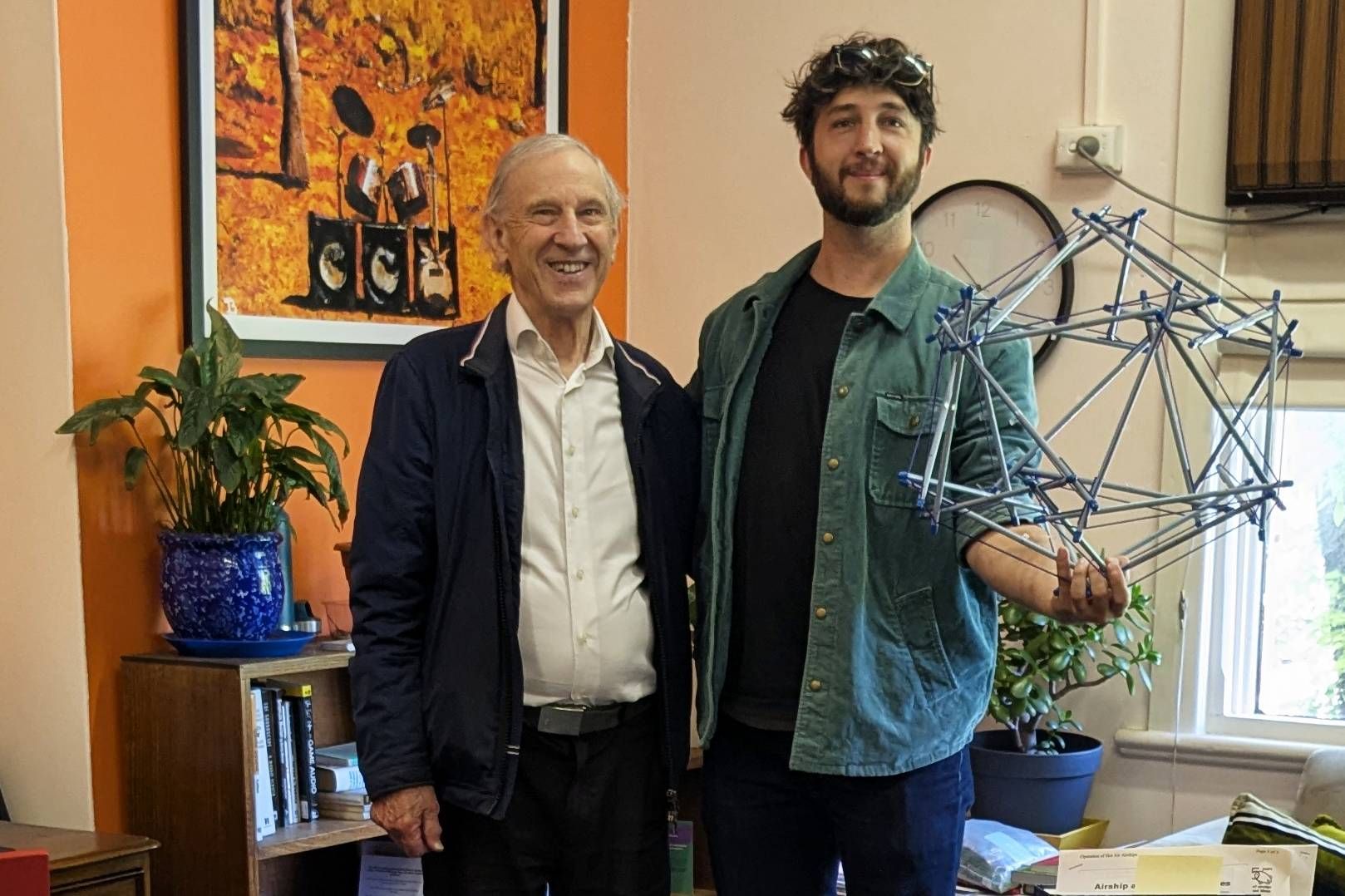
Toby Brandenburg was running laps of the Adelaide Park Lands, trying to sweat out a family argument.
His father, Brian, wanted to build an airship, like the blimps that drift over American football games. Only this one would carry forty-foot steel shipping containers across oceans.
For years, Toby had a laundry list of reasons why this wouldn’t work: too heavy, too hard to steer. Eventually, tired of arguing, he built a calculator to settle the debate.
At first, it proved him right. To carry one container, an airship would have to be ridiculously large. But it’s far less ridiculous if you want to carry a thousand.
Sitting exhausted in the damp grass, Toby realised the maths had turned against him. So he joined his father full-time, and together they founded Electric Air Shipping to get cargo airships off the ground.
The outsider
Brian Brandenburg calls himself a “dyslexic, failed STEM student”.
The eldest son in a strict religious family, he loved science at school and went on to become a teacher, then a librarian. Then, in the 1980s, when his own father could no longer run the family workshop, Brian left librarianship to take it over.
He managed eight or nine men who cut, ground and sprayed industrial machinery to keep the assembly lines running for major carmakers like Holden, Mitsubishi, and Bridgestone.
“I’m a bit of a compulsive problem solver,” he says.
Then Holden closed its Woodville plant, the first big domino to fall as cheaper imports undercut local manufacturers. Orders to the workshop disappeared one contract at a time as machines stood idle.
By the end of the decade, the family company was broke.
Giving hot air another chance
With the workshop gone, Brian started looking for another engineering problem worth obsessing over. In 2003, he began thinking seriously about airships.
“They have the potential to do things that can’t be done elsewhere,” he says. “But they’ve gone sideways for a long, long time.”
The world's very first hot-air balloons flew over France in 1783 by heating the air inside a massive paper-and-linen bag. Within months, inventors switched to hydrogen gas, which lifted far more weight.
But hydrogen was also highly flammable.
That danger claimed aviation’s first lives in 1785, when Pilâtre de Rozier and Pierre Romain were killed crossing the English Channel.
Then, on the evening of 6 May 1937, the world saw one of history’s most infamous disasters, as the hydrogen-filled Hindenburg burst into flames before a crowd of onlookers, killing 36 people.
"We stand on the shoulders of some giants," Brian says, "and some really big martyrs."
Brian wondered whether the far-safer option, hot air, deserved a second look.
Modern insulation could trap heat far longer than old fabrics, and the giant balloon roof of the airship could now be covered in solar panels to generate power.
Better yet, modern computers meant no crew had to be onboard – it could fly while controlled safely from the ground.
Built to be disproved
Toby was far more sceptical.
He was a musician by trade who had studied composition at the University of Adelaide. His artistic training gave him a specific way of thinking: take an idea, test it, and push it until it breaks.
“You make it more spiky, or you make it more heavy, or you make it bigger or smaller, or you can contrast,” says Toby.
In music, all of that happens before anyone hears the finished piece. Toby brought the same habit to his father's airship. For years the two of them went head to head at the dinner table, pushing aside plates to draw diagrams.
“I told him: ‘it will never work,’” says Toby.
While they argued, Toby worked a string of side jobs to fund his music career.
He pedalled a rickshaw for EcoCaddy, ferrying tourists between Adelaide's five city squares, clocking more kilometres than anyone else at the company.
He made trips into the APY Lands and the Flinders Ranges, shaping BMX tracks out of red dirt and fixing the wheels of kids’ bikes in communities most people never see.
Even so, Toby says he never thought of himself as an entrepreneur.
“I was looking for little side hustles,” says Toby, “rather than embracing the side-hustle message.”
A room of their own
In 2022, Toby needed a small office space to teach guitar. In exchange for his father's support, he struck a deal to test the airship idea once and for all.
“If you’re going to bug me all the time about this airship,” Toby told him, “you can help pay the rent on this little office.”
Toby still assumed the project would fail. At worst, he figured, they might get a fun story or a video game out of it.
While Toby taught guitar lessons, Brian hit the books. He found the Airship Association, a small group of aviation experts based in London with archives dating back decades.
“Only 170 members, but it's much more powerful than the equivalent association in the United States,” says Brian.
Its journals revealed how airships stay afloat, how their outer skins handle strain, and why old-school airships were so hard to park on the ground.
Soon enough, Brian was turning up to arguments with Toby armed with equations, test results and historical flight data.
The calculator
Brian’s early design looked like a massive flying saucer with a shipping container hanging underneath it.
Toby coded a calculator program to double-check the physics. He plugged in the dimensions, weight, and air pressure, then waited for the answer.
The ship would have to be colossal. Unreasonably huge.
The Hindenburg was 245 metres long. Brian's saucer would need to approach that size just to lift a single shipping container.
“After so many years of trying to poke holes in the idea, it was kind of devastating,” Toby says.
But the program also revealed more about a powerful mathematical property: the square–cube law. As an object grows bigger, its inside volume expands far faster than its outside surface area.
This is the same law that explains why an ant scaled up to elephant size would collapse under its own weight: its body grows way faster than the strength of its skinny legs.
For an airship, this rule works in reverse! Double the size of a balloon, and the skin area gets four times larger – but the air inside gets eight times larger.
The bigger you build an airship, the more air it holds, and the exponentially more weight it can carry. Make it big enough, and it can easily lift itself and tons of heavy cargo.
“Anything could work as an airship if you made it big enough,” Toby says. "Crazy big"
The obvious way to make an airship bigger was to make it longer. But with this, there was an obvious limit. Nobody was going to build a kilometre-long aircraft.
Finding a shape for an airship
Most airships look like gigantic, floating cigars. They are long, thin, and pointed at both ends. When you make a traditional airship bigger, it usually just gets longer. But it could, Toby reasoned, also be made taller and wider.
Mathematically, the ultimate shape for holding air is a sphere.
Think of a giant rubber beach ball – it holds the maximum amount of air inside the smallest possible skin.
But flying a giant ball is a total nightmare. Without a clear front or tail, steering and landing are almost impossible. Toby had to find a middle ground: a shape round enough to hold a huge amount of air, but shaped tight enough to cut through the wind in one direction.
“I became hyper-obsessed with the design,” he says.
For six months in late 2024, he was the first person to unlock the office doors every morning and the last one to turn off the lights at night.
Whenever he closed his eyes, his brain transformed the world around him. Buildings, coffee mugs, and chairs started spinning inside imaginary glass globes.
A shape that rights itself
One afternoon, Toby’s twin brother Sam walked into the office.
Sam was testing a new 3D printer for his IT job. One of the test files on the machine was a colorful, strange-looking object that resembled a lumpy fat egg. He printed three of them out and dropped them on Toby’s desk.
“I reckon this could be useful,” Sam said. ”It’s got some interesting properties.”
The object was called a Gömböc.
It had been an open question in mathematics, until two Hungarian researchers had shown that it could exist in 2006.
If you set a Gömböc on a flat table in almost any position, it will automatically roll and wobble until it pops back upright on its own – without any weights or moving parts inside.
More importantly for Toby, it combined the volume of a rounded body with an unmistakable orientation – something a sphere couldn't provide.
“It was like someone had given us the correct answer,” he says.
The Sunship
The resulting airship, dubbed the Sunship, looks nothing like the blimps of the past.
There is no explosive hydrogen or expensive helium inside – just an enormous, super-insulated chamber of heated air. Solar panels line the top skin to generate power, while vents open and close to control heat and altitude.
With its Gömböc-inspired shape, the Sunship can hold 20 times more hot air than a traditional cigar-shaped airship of the exact same length.
“Twenty times more air is far more lift,” Brian says.
Solving the shape introduces a new problem: where do you put an aircraft that big? Old airships depended on giant hangars and teams of people holding ropes to guide them in and out. Many were torn open or crushed by wind before they even flew.
Brian wants the Sunship to live permanently outside.
“No one builds a skyscraper inside a great big hangar and then drags it out,” he says. “It’s got to be strong enough to live in the wind all the time.”
Instead of landing at busy cargo yards filled with cranes and trucks, their plan is to park the Sunship over water, loading and unloading cargo from floating barges.
For now, the Sunship exists as a series of heavy mathematical models and computer designs. To test their ideas, the duo built a mini wind tunnel in their office, using smoke and tiny 3D models to see how air flows over the hull.
Brian describes their work as a process of “shrinking uncertainty.”
The $110,000 box
Today, companies moving freight across the world face a tough choice.
They can use cargo ships, which are cheap and slow, or planes, which are fast and outrageously expensive.
Toby and Brian saw that decision first-hand after meeting a businessman whose ten-foot container missed its scheduled sailing.
The voyage was meant to take eight weeks and cost $5,000. With no replacement ship available, air freight became the only option.
Even flying at hundreds of kilometres an hour, loading and transfers meant the container still took two weeks to arrive. The bill was $110,000.
“If there’s a middle option, much faster than a ship, maybe slightly slower than a plane, but way cheaper, and emissions-free, that’s the dream,” Toby says.
There’s also the environmental cost. According to the International Maritime Organization, international shipping produces roughly three per cent of global greenhouse emissions.
Brian hopes a solar-powered, electric airship could transport heavy freight across the planet without burning a drop of fossil fuel.
Coming out of hiding
For nearly three years, Electric Air Shipping was just two men working in a tiny room, telling almost no one what they were up to.
The privacy helped them focus – but it also meant fewer outsiders around to push them when they were right, and catch them when they were wrong.
“There’s a big price for that focus,” Brian says.
A friend introduced Toby to Stone & Chalk's Adelaide Startup Hub. They moved in almost within a week and began pitching their idea to real-world aerospace engineers, investors, and business advisers.
“Getting their feedback is kind of scary,” Toby admits. “But the learning – that’s been really worthwhile.”
Their research has now appeared in the Airship Association's journal, and the founders are presenting their work to potential customers and team members.
“It just feels like things are accelerating week on week,” Toby says. “My calendar is literally getting fuller every week. It feels like moving in the right direction.”
What 20 years taught them
Toby's advice is not to worry too much about looking like a founder.
“I’d just go and do a whole bunch of really cool, crazy, interesting stuff, and learn how to connect with all sorts of different people,” he says.
“There’s no point trying to solve a problem that isn’t real. Build up your life experience and the strength of your character. That’s probably more important.”
Brian's lesson is different. He thinks they spent too long working alone.
“The other key thing we were never able to find is having a mentor,” he says. “You can do things so quickly if you've got insider knowledge.”
He believes local communities and new technology now make it easier than ever to get expert-level guidance without needing to, as he puts it, "fly to New York and hope to meet someone."
Back in the Adelaide Park Lands
Toby no longer runs angry laps trying to make the airship smaller.
The size that once looked like the fatal flaw in his father’s idea may be the very reason it can work.
After years of trying to pop the airship dream his father had carried for nearly two decades, Toby is working side-by-side with him to make it fly.
