
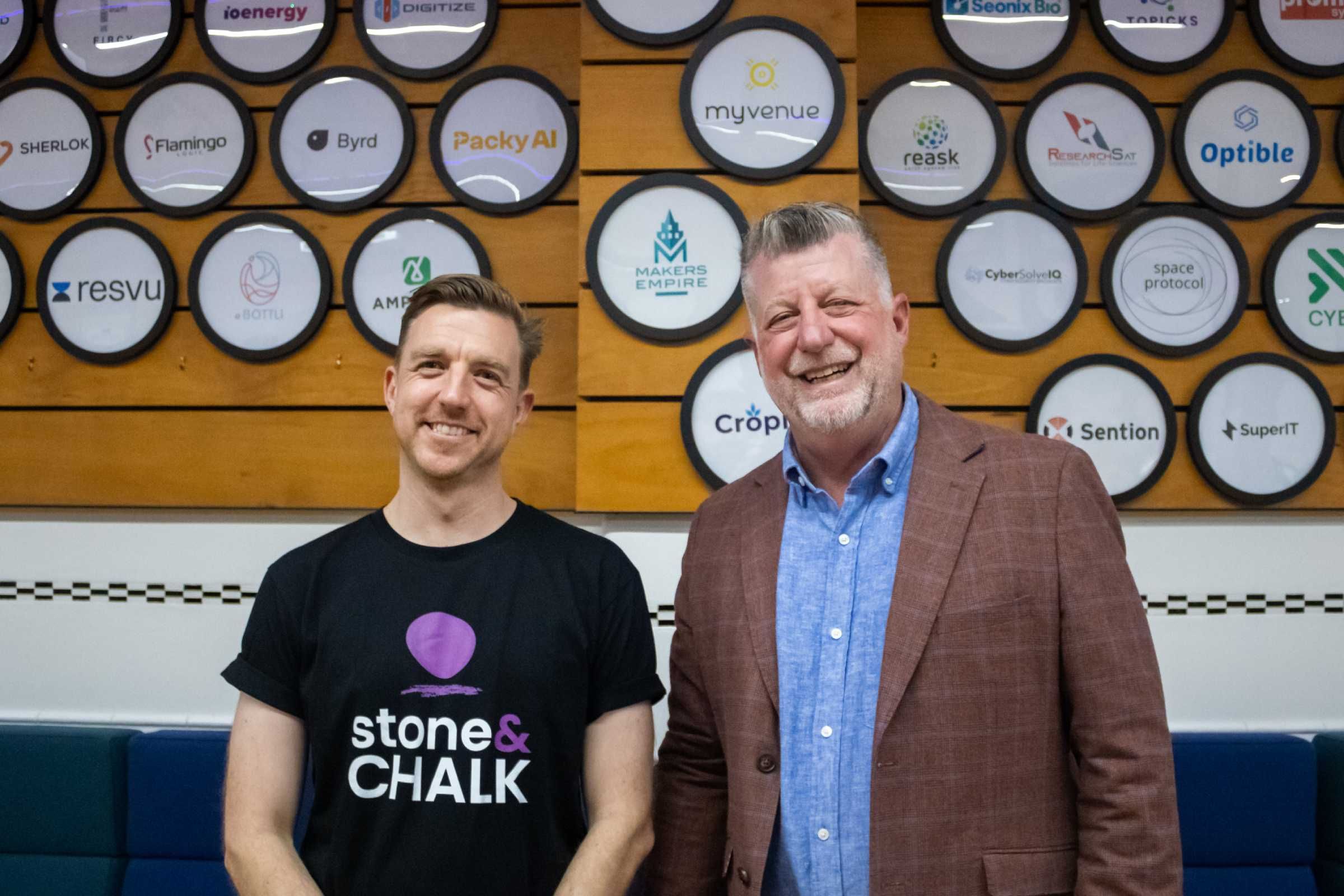
“Starting a company is a deeply traumatic experience,” Tim says with a wry smile. “So why did I do it? Because I believed in it.”
That belief has carried him further than he ever imagined.
Tim Stollznow is the founder of MyVenue, an Australian point-of-sale system that now runs food and drink sales in almost 200 stadiums across North America.
It’s used in places millions of fans dream of visiting, like the Super Bowl and the Grand Prix, and is locked in for venues tied to the 2028 Olympic Games.
His journey to the world stage is one of resilience, calculated risk, and an unshakeable belief that Australian technology could compete, and win, internationally.
Growing up on the outside
Tim spent his early childhood in a remote Northern Territory community near Alice Springs.
Life was quiet, tight-knit, and a long way from the cities most Australians call home. But it wasn’t until he was sent south to boarding school, he quickly found out he wasn’t like the other kids.
“You come down without a favourite football team, not knowing the TV shows or the bands, you just don’t fit in,” he says.
That feeling of being on the outside taught him a skill that would become essential in business: resilience. “You have to learn to adapt. That’s the same muscle you need to build a startup,” says Tim.
His first taste of entrepreneurship came in the 1990s with startup Quest Retail Technology, a venue point-of-sale business he drove to international success before being acquired by Radiant Systems in 2008.
The experience was intense enough to make him vow, “never again.”
He spent the next few years’ in service to community organisations back in Alice Springs. Yet by 2019, he felt the pull to innovate once more.
Spotting a gap no one else could see
Tim had kept an eye on the sports and entertainment industry over the years, and knew that speed of service and labour was critical to venues.
“The point-of-sale systems they were using hadn’t evolved,” he recalls. “I could see there was space for a provider that really understood the market.”
Making it happen was a different story. MyVenue got a break when Tim secured an Accelerating Commercialisation grant from the Federal Government, up to $540,000.
There was one big condition: he had to match it. So Tim had to do the thing so many founders dread, raise money for a product that didn’t exist yet.
“It was pretty hard,” he admits. “I went and saw all these people and they were like, ‘Nah. Nah. Nah.’”
Eventually, the cheques came, often in $25,000 chunks from friends and family, building on the strong relationships he’d built over the years. “In the end, we raised just over $500,000,” he says.
But using money from people you love adds another layer of pressure. “When you take money off your mates, you’re accountable in a different way,” he says. “You’re going to be a pretty lonely guy if your business goes broke.”
Launching as the world shuts down
By early 2020, MyVenue had built its first product: a mobile ordering system that let fans buy from their seats.
Then COVID hit. Stadiums shut. The entire hospitality industry went into hibernation. “By March, I thought, this is the stupidest idea I’ve ever had,” says Tim.
But the shutdown forced a new kind of creativity. He installed a single terminal in a local coffee shop just to keep testing the product. And then, with Australian venues closed, the United States, which was still hosting limited-capacity events, became an unlikely lifeline.
His lucky break came through a friend of a friend, who had just bought a minor league baseball team in Kansas City. “They became our first U.S. customer,” Tim remarked.
A new door to opportunity
In Kansas City, one of their local technology installers heard an interesting piece of news. The Miami Dolphins might be looking for a new point-of-sale system.
Soon, Tim had a meeting lined up at Hard Rock Stadium. “Once you have one customer, it’s easier to get the second,” he says.
But the Dolphins were upfront: they didn’t know who MyVenue was, and they weren’t sure the product would hold up. But they had a deadline and they were willing to test. “We’re going to give you a chance,” Tim was told. “A pilot.”
Sixteen terminals were installed across two concessions during the 2021 NFL season. At the end of the season, the verdict came back positive. The Dolphins liked the product, and the team behind it.
They invited MyVenue to roll out the system at the Miami Open tennis tournament. This meant going from a simple pilot to serious scale, fast.
Scaling under pressure
By 2022, Tim and his wife, Michelle, were spending more time in the USA than at home, overseeing installations in some of the busiest stadiums in the country.
“There are two overwhelming emotions on game day,” Tim says. “One is the most excitement you could ever imagine. And the other is the biggest fear.”
Because when the gates open and the crowd pours in, people aren’t patient. They’re hungry, thirsty, and ready to spend. If the system stalls, the whole venue feels it.
“What happens if you can’t serve beer on time?” Tim says. “We’re part of the machine… it better work.”
To cope with that pressure, MyVenue built a mature critical incident management plan – redundancy in systems, clear communication protocols, and rehearsals for worst-case scenarios.
“We practice it,” Tim says. “Everyone knows who to call, what to say, and how to keep the system running.”
Because it has to work. The scale leaves no room for error. “Last Saturday we did over 455,000 transactions right through our system,” Tim says. “Last month we did over $200 million worth of transactions.”
Yet even with all the systems, checklists, and safeguards in place, Tim keeps coming back to something far less technical: people.
“I think communities like Stone & Chalk are amazing,” he says. “The energy you get from being around startups is incredible, not just for me, but for the whole team.”
When the pressure is constant and the stakes are high, having a culture you can rely on makes all the difference.
The cultural divide: Australia vs the USA
After years moving between Australia and the United States, Tim has noticed a contrast that still surprises him.
“Australia’s got great engineers, great tech, really smart people,” he says. “But we’re not very good at buying products.”
For Tim, support starts with action. “The best way you can support a startup is to buy their product,” he says. “And if you do buy their product, be prepared to back it through its first couple of failures.”
America, by contrast, is a massive consumer market driven by competition and a powerful fear of missing out.
“One of the reasons America backs its companies so fiercely is that fear,” Tim says. “There’s so much competition. If you don’t move, someone else will.”
That mindset ended up being pivotal for MyVenue. Tim talks about moments where the contrast felt almost absurd, where what counted as “credible” depended entirely on which side of the Pacific he was standing.
“We’d already been signed to NFL Stations in the U.S. and a bunch of other agencies,” he says. “Then we’d come back to Australia and hear, ‘We’re a bit nervous about buying from a startup.’”
For Tim, it was disappointing, but it also highlighted the opportunity to think beyond one market and look globally, sooner than they might expect.
Lessons for founders
When Tim looks back on what actually helped MyVenue get off the ground, he doesn’t talk about one magic break. He talks about a few simple things done consistently.
First, he says you’ve got to truly believe in what you’re building, because if you don’t, nobody else will either. “If you want to start a company, you better believe in what you’re all about to do.”
But belief alone won’t carry you. He says you also need “some sort of a plan on how you’re going to get that first customer,” because progress only comes from someone choosing to use what you’ve made.
The second lesson is about getting your hands dirty early, before anything is slick or scalable. In Tim’s world, that looks like doing whatever it takes to get the product into someone’s hands – even if it’s a bit awkward.
He networked relentlessly at U.S. trade shows, following potential contacts to after-hours bars to grab a five-minute conversation. “Whatever you can do to create an impression, without ending up asleep under the bar, is worth it,” Tim says.
And the third thing, Tim says, is not waiting until you’re “big” to put support and accountability around yourself.
He’s clear that he’s “a firm believer in governance,” not because it slows you down, but because it forces you to think clearly about risks, cashflow, priorities, and what you’ll do next. And when it comes to getting a board or an advisory group, his rule of thumb is simple: “Straight away. As soon as you can.”
Looking ahead
Today, MyVenue processes millions of transactions every month and supports some of the world’s most high-profile venues.
The next stage is deeper penetration in the U.S. and exploring opportunities in other international markets. “We want to be the most trusted, innovative point-of-sale platform for large venues anywhere in the world,” Tim says.
It’s an ambitious target, but so was taking a South Australian startup to the NFL, and they made it happen. Who knows what else is possible.
