
It’s six o’clock on a Tuesday evening. The automatic doors at your local Woolworths slide open.
You grab a trolley and take a left into the soft drink aisle. Your eyes slide over rows of labels until a bright yellow ticket snaps you from your daze.
HALF PRICE.
You pick up a 2L bottle, do some quick mental maths, and pop it in your trolley. The whole decision takes less than ten seconds.
But behind that small slip of paper sits a multi-billion-dollar industry held together by spreadsheets, copy-paste, and human endurance.
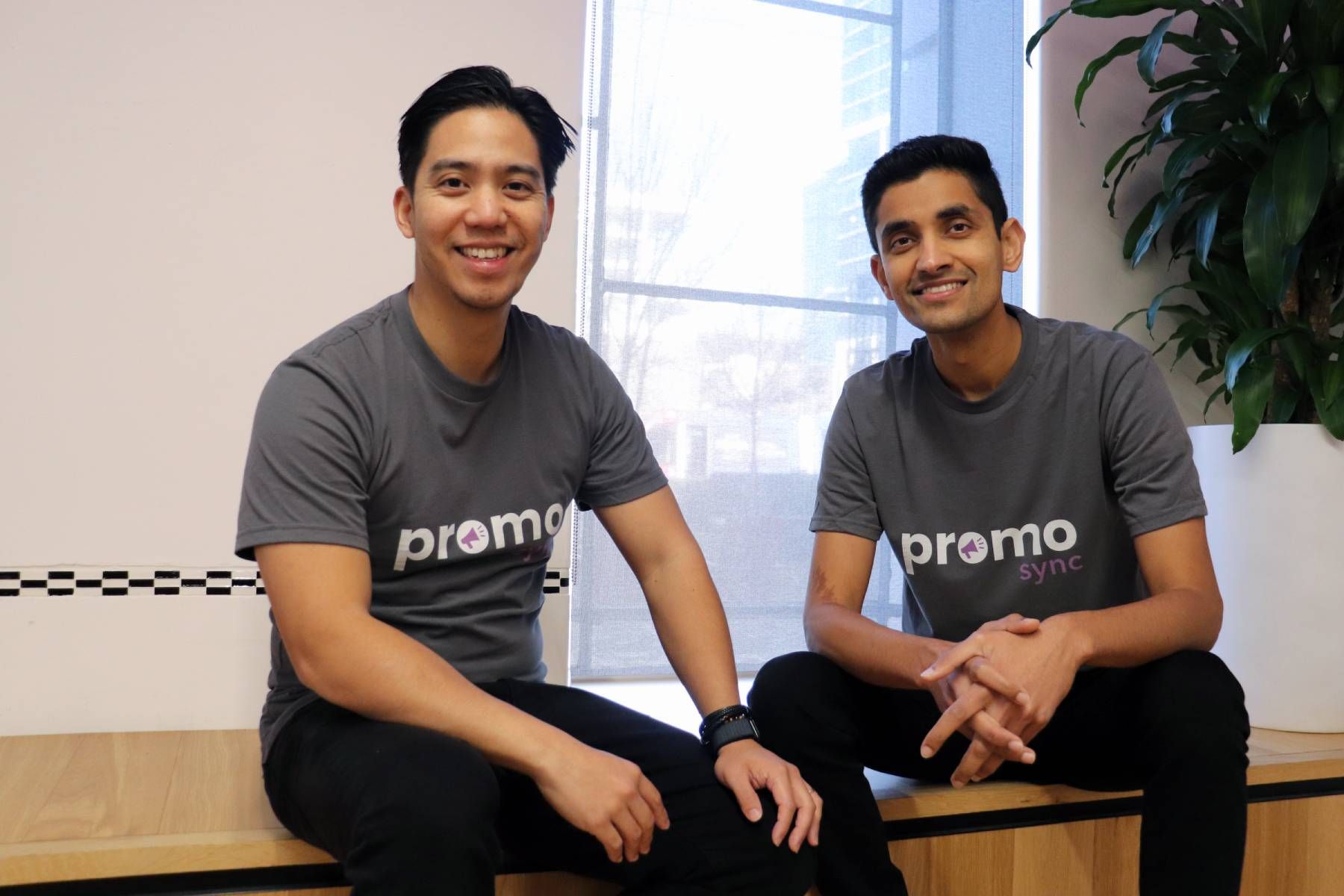
This is the story of PromoSync, a South Australian startup founded by Henry Choo and Divyanshu Chauhan, who are using AI to tackle one of the most expensive problems in the supermarket supply chain.
A second child and a hard call
Henry wasn’t supposed to be in a startup.
His career at Nestlé sat him comfortably inside the machinery of global consumer goods, where he managed trade promotions (the yellow ticket discounts). At home, he had a wife, a young child, and a second child on the way.
Then the pandemic hit. “We suddenly realised we couldn’t manage two children on our own in Sydney without family,” says Henry.
So Henry stepped away from his corporate role. They packed up their lives and moved to Adelaide, his wife’s hometown, to be closer to family.
Henry soon found a remote position with a San Francisco tech company, Speakeasy, where his days were split between Zoom calls and bedtime stories.
But as he dove deeper into startup life, Henry recognised that a frustration from his old life might just be possible to solve with the knowledge from his new one.
The hidden cost of “half price”
To understand what bothered Henry, you have to understand trade promotions.
When you see a yellow ‘half price’ ticket on a supermarket shelf, you might assume the supermarket foots the bill. In reality, the company that makes the product pays for it.
Take Coca-Cola. If Coca-Cola wants to run a half-price discount on a $4 bottle of coke, they must pay Woolworths (who still expects to receive the full price) the missing $2 to cover the cost of the promotion.
But long before that yellow discount ticket appears, Coca-Cola must first predict the answer to a critical question: will this promotion make or lose money?
To find out, people like Henry must dig through mountains of historical sales data, analyse the results, and work out what drives the outcome and what is just coincidence.
The analysis itself is hard, but manageable. The real frustration is the process around it.
“Everything was manual,” Henry explains. “I had to pull data from different places and build huge Excel spreadsheets - just to get a simple answer. It could take me a week or two to work out what actually went right or wrong.”
That’s just the start. Once a promotion is approved, the real burden begins.
“To run promotions for one brand in one retailer for a year is about 50,000 manual data entries,” says Henry.
Each product has its own ID. Each promotion has its own codes. Retailer systems don’t match manufacturer systems. One misplaced decimal or incorrect code can have serious consequences.
“Sometimes there’s no stock because the process went wrong,” says Henry. “The product never arrives in the store even though there’s a promotion planned.”
The stakes are enormous. For many companies, trade promotions are the single biggest expense on the profit and loss statement.
“In a business that makes about $100 million a year,” Henry says, “roughly $50 million of that can go into promotions: discounts, catalogue placements, in-store specials and other deals.”
The most troubling part, Henry says, is that “over 50% of all that spend doesn’t even break even.” What looks like a win for shoppers is often a loss for the company.
Henry had seen enough to believe it didn’t have to be this way. So he set to work and founded his own startup, PromoSync.
A second arrival
Solo founder life is hard. The hours are long, the problems pile up fast, and for Henry the biggest gap was technical. He needed someone who could help build the product.
Then in comes Divyanshu (Div) Chauhan, a software engineer of the purest kind. Div completed a Master of Artificial Intelligence at the Australian National University before working across a series of startups in Sydney.
Then COVID hit, and a small household frustration turned into a new startup idea.
His wife, Sanjam, was getting home recipes from her family in Delhi through voice notes and long WhatsApp messages, a nightmare for two self-proclaimed ‘non-chefs to follow.
At one point, Sanjam turned to Div and said, half joking, half serious: “You’re the engineer. Just build a blog for me.”
What emerged was Chefadora, a platform he and Sanjam built so people could share their culture through food without needing to become tech experts or full-time bloggers.
“It started growing. People asked, ‘can I publish my recipe as well?’ Then other creators started wanting to use it,” says Div.
So they quit their jobs, moved to Adelaide to ease the cost of living, and started building at Stone & Chalk.
How Div and Henry found each other
Div joined Stone & Chalk on the very same day Henry did.
At their first Sweet Spot, they were introduced back-to-back. Later, upstairs, they ended up seated beside each other.
Their collaboration started with small acts of help. Div was wrestling with a problem many early founders face. “I figured out how to get sales calls,” he says, “but I was not able to convert them.”
Henry offered to sit in on a few of the conversations. He listened carefully, then suggested a handful of small changes. The difference was immediate.
“Suddenly our conversion rate went from around 20% to about 90%,” Div recalls.
Div returned the favour. He took Henry’s vision for PromoSync and turned it into a working system.
“He built a full enterprise-grade solution in days,” Henry says.
Together, they each unlocked a critical gap in the other’s business: one lifted revenue, the other delivered the product. But technical skill and commercial insight alone are not enough to build a company together.
“You can spot a skills gap,” says Henry. “What’s harder is finding someone whose values align. But when you work side-by-side every day, that becomes more obvious.”
Then, like any strong partnership, they spent time together outside work, met each other’s families, and paid attention to how the other person handled stress and uncertainty.
Once that trust was there, they formalised the partnership and Div joined Henry as a co-founder of PromoSync.
Working together to build
As their partnership deepened, the product evolved with it.
Trade promotion systems are notoriously complex. New users often need formal training just to navigate them, and much of the process assumes years of internal knowledge.
Div and Henry saw a cleaner path: “We can extract all of that into a chat interface,” Div explains. “People should be able to just talk to it.”
Instead of moving through layers of dashboards and reports, a user could simply ask a question as it came to them: ‘What happened the last time we ran this promotion?’ or ‘How did our last catalogue special perform at Woolworths?’
The system handles the rest – pulling the data, analysing it, and returning clear answers, all without pivot tables or complicated queries.
“The opportunity is in going deep on one industry,” Henry says. “You have to understand the nuance.”
Those nuances are exactly what make the problem hard to solve and worth solving.
Finding startup success
Their progress earned them a place in Startmate, one of Australia’s most competitive startup accelerators.
Out of more than 730 applicants each year, less than 2 per cent are accepted - and PromoSync was the only team from South Australia in 2025. But Henry is quick to point out that the real win was something else:
“The biggest achievement is that we didn’t quit. It’s easy to stop when the money’s not coming in, when your co-founders leave, when you’re balancing kids and trying to believe in an idea no one else sees yet.”
They’re also committed to growing their team in South Australia.
“There’s a lot of FMCG talent in SA,” says Henry. “Sales reps, supply chain managers – people who’ve lived this problem. As we scale, we want to hire locally and build something here that has national and global reach.”
The pair are also committed to giving back: “We’ve taken the 1% pledge,” Henry says. “From day one, we baked in the idea that we want this to contribute to something bigger.”
Lessons for other founders
Building software while pushing through long sales cycles asks more of you than optimism.
“Sometimes you have imposter syndrome,” Div admits. “You wonder, do I even belong?”
What kept them moving was not blind confidence, but repeated proof that the problem they were solving was real. That proof came from talking to potential customers.
“Every conversation teaches you something useful,” Div says.
That is why Henry’s advice to new founders is to invest in relationships early.
“Investing in your network is very important. I used to have a budget of $100 a week that would be spent on taking people out for a coffee. I saw that as an investment in my future.”
Together, they’ve built a company that solves a painful industry problem and shows what can happen when trust, timing and complementary skillsets line up.
As Henry puts it, “It’s not competition that kills startups. It’s co-founders who can’t work together. We took our time, built trust, and now we’re building something that matters.”
Returning to the aisle
Next time you’re standing in the supermarket, pause for a second.
Look at the yellow ticket. The one tucked beneath the bottle, bright and simple, asking for nothing more than a quick decision.
Behind that small square sits weeks of work, spreadsheets stacked on spreadsheets, and thousands of tiny decisions entered by hand.
Now that friction is starting to fall away, thanks to two founders who happened to land in the same place, on the same day. And you’d never know, unless you stopped to look a little closer.
