
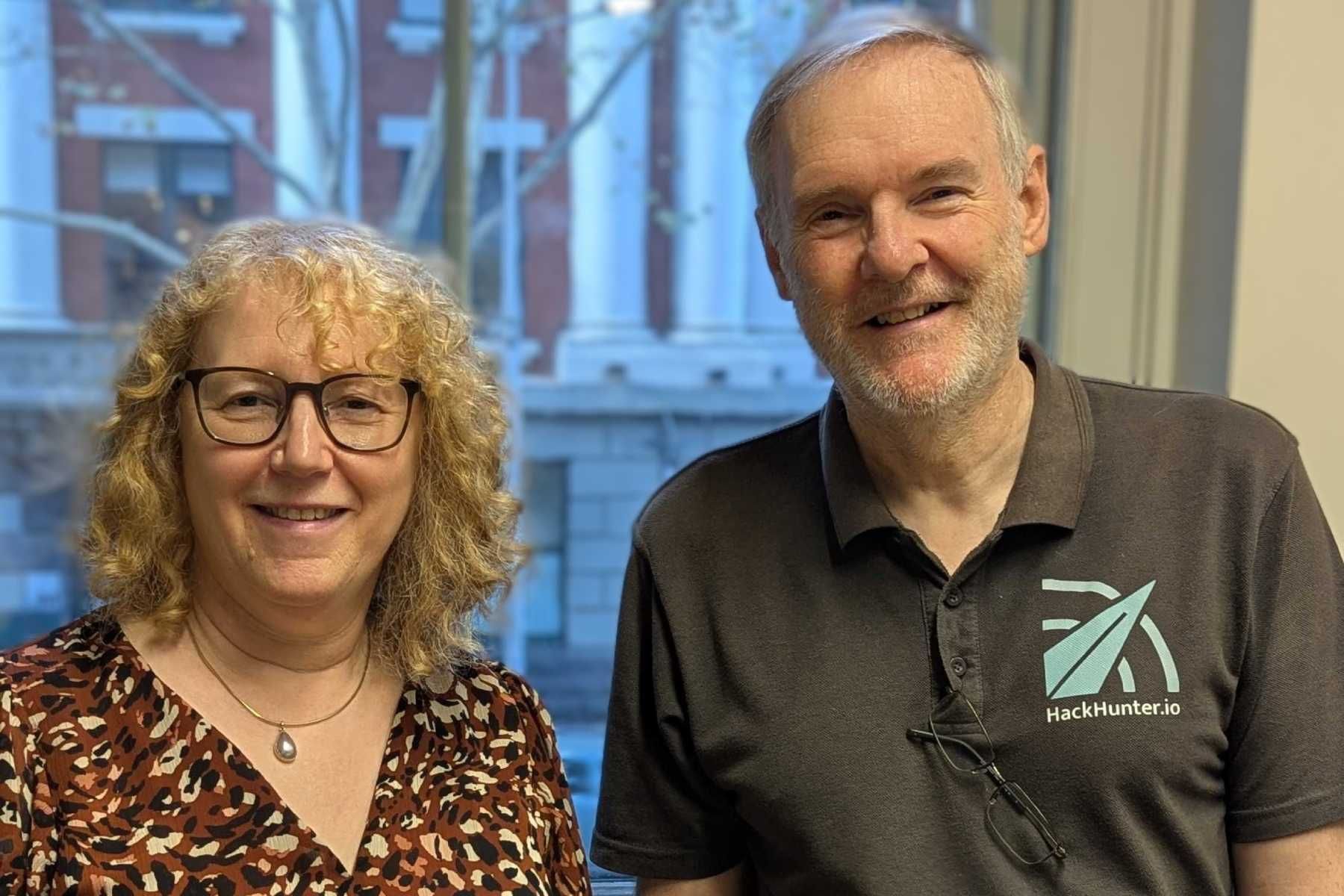
“We could have retired, but we had unfinished business,” says HackHunter CEO Tracie Thompson.
Never one to take the easy option, Tracie Thompson and her husband Mike Thompson (Co-founders of HackHunter, and the company’s CEO and CTO respectively) set out to solve a problem no one else had.
The result is HackHunter, a Melbourne-based security company now helping organisations around the world detect, analyse and locate wireless threats such as phones, cameras and bugs.
What began as a simple idea has now evolved into a globally deployed suite of products used by governments, corporates and law enforcement agencies, turning previously invisible risks into actionable intelligence.
A Christmas like no other
On Christmas morning in 2017, while most families were unwrapping presents, Tracie Thompson was in the kitchen preparing lunch when her husband Mike burst in with excitement.
“I’ve got it!” he said.
Tracie’s response was realistic, if not slightly dismissive. “I’m making lunch for the family. I don’t have time to look at it now.”
That moment, half chaotic, half ordinary, would later mark the beginning of HackHunter, a Melbourne-based start-up solving a problem no one else had.
The breakthrough Mike was so eager to share had started unexpectedly on Reddit. He had come across a simple question: ‘I think someone is hacking my Wi-Fi. How can I find out who is doing it?’
At the time, there was no clear answer. Even experts, including software engineers were responding with, ‘there’s nothing you can do.’
Mike took this as a challenge. He told Tracie, “I can solve this”.
For most, it was an unanswered frustration. For Mike, it was a problem worth solving.
That instinct, to take on a challenge others hadn’t solved, was something he and Tracie already shared.
By that point, they had built and sold a successful business together. They understood how to work as a team, with clearly defined roles: Mike as the inventor and technical mind, Tracie as the one who runs the business and brings structure.
They could have chosen to step back. Instead, they chose to start again.
“What I love most is challenging myself,” Tracie says. “It’s incredibly rewarding to solve a problem people don’t think can be solved.”
From consumer curiosity to global security
HackHunter didn’t begin as a national security product.
The original concept was much smaller: give individuals visibility into the Wi-Fi networks they are using, particularly those concerned about network safety.
But as the product evolved and early users began testing its capabilities, its potential quickly expanded.
Over time, HackHunter transitioned into a completely different category. They are now supporting government agencies, large scale corporates and law enforcement in complex, high-stakes environments.
Today, the company operates globally, with its strongest markets in the Five Eyes alliance which includes the UK, the US, Australia, New Zealand and Canada.
“We’ve actually been pulled offshore,” Tracie says. “We’re not chasing customers, they’re coming to us.”
Much of that growth has been driven by word-of-mouth, with customers actively introducing HackHunter to peers across agencies and regions.
Solving high-stakes problems
HackHunter has three products each evolving substantially over the last 8 years.
The Pursuit Tracker, HackHunter’s original invention is a handheld device with a screen much like a phone which acts as a Technical Surveillance Countermeasures (TSCM), or bug sweeping tool.
It can track down any Wi-Fi device to within centimetres, even if they are in a ceiling or floor.
Customers have exclaimed they used the Pursuit Tracker to find rogue Wi-Fi access points in vending machines, coffee machines and even an air purifier! In one case, a non-profit in DC expressed concerns their board meeting was ‘bugged’, and the Pursuit identified data being transmitted unwittingly from a board member’s phone, later discovered to contain malware.
The device is especially useful for large corporations who must sweep executives’ cars, offices and the board room before every important meeting. “It protects information that could be worth billions,” Tracie explains.
Hackhunter’s second product is the Vision continuous monitoring sensor.
Tracie describes this device as “CCTV for Wi-Fi”. The device continuously scans the environment and alerts when a specified or unexpected Wi-Fi device or behaviour is detected.
HackHunter has also developed a third product, for national security, which is in great demand by law enforcement, government and defence in Five Eyes and NATO countries.
Powered by people and place
HackHunter’s journey has been closely tied to Melbourne’s startup ecosystem, including Startmate, CyRise and Stone & Chalk.
“We’ve been at Stone and Chalk since the beginning,” Tracie states, “It’s energising, compared to working at home alone.”
For Tracie and her team, the value extends beyond infrastructure.
Given the complexity of their work – bringing together hardware, firmware and software – those in-person moments are critical. But so too is the culture.
“The team loves it,” Tracie says. “Especially the younger team members, they have lunch with interesting people, play basketball, play pool. It’s a great place to be and a great place to network and learn from others.”
Choosing substance over hype and trends
Tracie’s advice to other founders reiterates that building innovative hardware in Australia is not without its challenges, especially regarding funding.
“Cyclical fashions come and go,” Tracie says. “It’s best to avoid the hype because those things can be fleeting.”
Instead, HackHunter has focused on solving a real, enduring problem. “Wi-Fi and hardware aren’t seen as exciting, but they’re sustainable,” Tracie explains.
That decision has helped the company build a strong, defensible position, supported by local manufacturing and a long-term approach to innovation.
It has also required persistence. “When you’re inventing something new, it always takes longer than you think,” she says.
Tracie reiterated the need for initial funding. “We were lucky we’re a bit older. We’d sold a business and had the resources to take a risk,” she confessed.
“For younger people, maybe they are also trying to buy a house, or start a family and they really need to have resources to keep going, and inventing especially takes time,” she empathises.
Still solving what others can’t
Eight years on, HackHunter is a very different company from where it began. The technology has evolved. The customers have changed. The applications have expanded.
But the underlying motivation remains the same. To take on complex problems. To build something meaningful. To keep pushing into spaces others haven’t solved.
For Tracie, that challenge is still the most rewarding part, and it’s what continues to drive HackHunter forward.
