
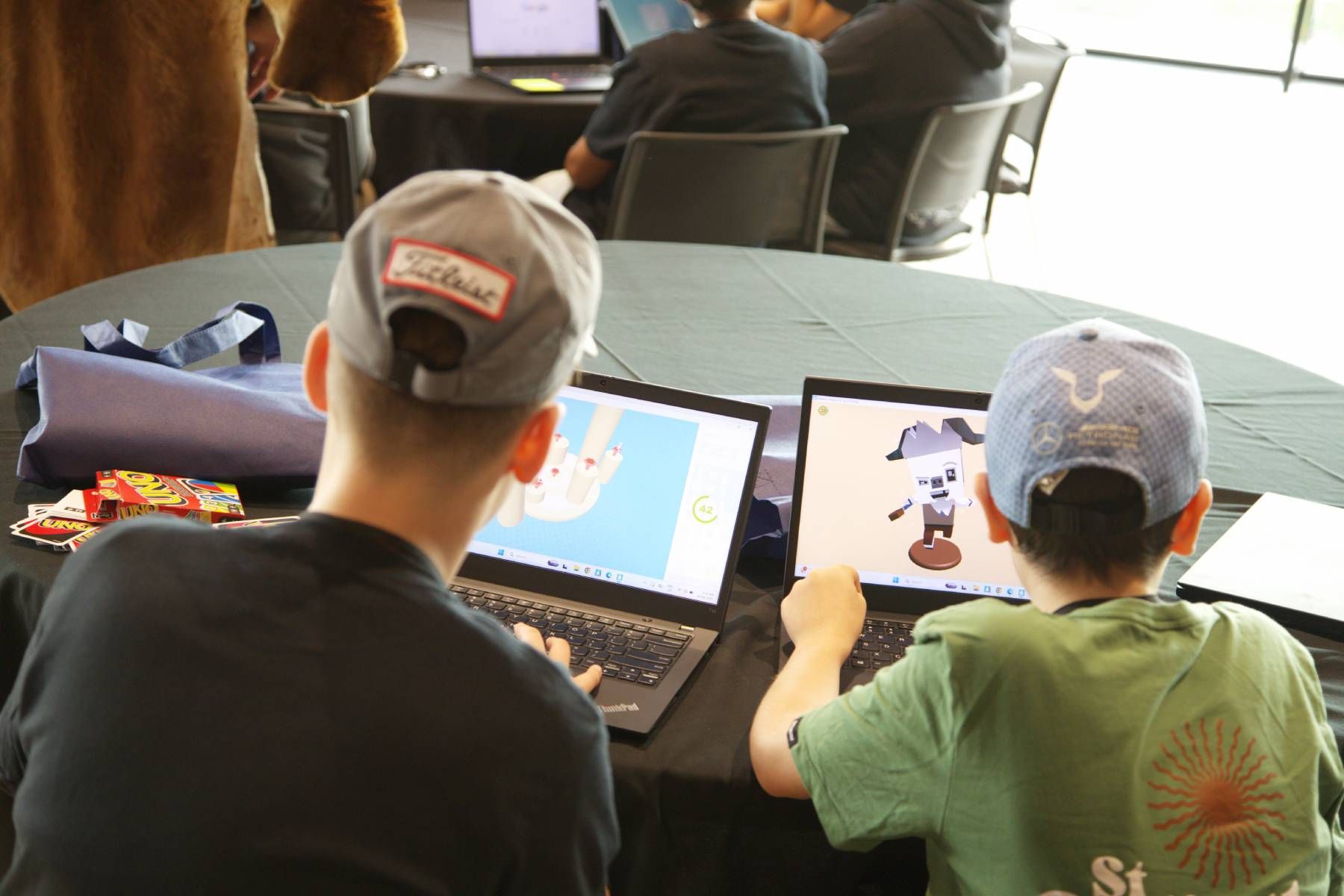
A student leans over an iPad, dragging shapes into place with the kind of joyful concentration adults usually reserve for wine tasting. Across the room, a 3D printer hums to life and a small plastic object begins to form like magic.
Not long ago, this kind of classroom lesson would have ended in cardboard, glue sticks and a lopsided model drying near the window. Now, a student can imagine a design, create it on a screen, and hold it in their hands before the school day’s out.
That change sits at the heart of Makers Empire, an Adelaide-founded edtech company led by Jon Soong to help children become creators, not just consumers, of technology.
Turning an idea into a business
The original insight grew out of an experience from Jon's co-founder Roland Peddie.
Roland spent years working on open-world video games in Scotland. It was here he noticed that young players weren’t just roaming the worlds developers had built for them. They were spending hours creating things inside them: designing outfits, building homes, fixing up their own tiny corners of the game.
"Kids loved making stuff for their characters more than they actually liked playing the game," Jon explains.
Back in Australia, Roland followed that thread and built a simple 3D design tool for children. He showed it to his daughter, who picked it up quickly. Then he showed it to Jon.
Faced with an opportunity, Jon had to work out what to do with it. Who was it for? Could it become a real business?
Finding the problem inside schools
When Makers Empire launched in 2013, STEM (Science, Technology, Engineering and Mathematics) had not yet become the dominant conversation in education.
But the introduction of the Australian Curriculum in 2014 gave design thinking a place inside a new subject called Design and Technologies.
Suddenly, from the early years of primary school, students were expected to identify problems, build prototypes, test them, improve them, and explain their thinking.
Jon saw a product that could sit right in the middle of that shift.
"These skills are not exclusive to STEM," he says. "They're important if you're going to build companies, and in a wider sense too.”
“The collaboration, the communication, the critical thinking – those are things you really want young people to learn as soon as they can."
Jon believed 3D printing could bring those lessons to life
A 3D printer works a bit like a computer-guided glue gun. Instead of laying ink on paper, it squeezes out thin lines of warm melted plastic and builds an object layer by layer.
With Makers Empire, students could design an object on a screen, send it to the printer in their classroom, and watch it take shape in front of them.
“Before, it would be cardboard and Paddle Pop sticks,” says Jon. “Now you can design something with a 3D printer that is high quality, relatively cheap and really fast.”
Instead of stopping at a sketch or rough mock-up, students could hold the idea in their hands, test whether it actually worked, and then go back to the design and improve it.
Building for real schools
Selling into education is a notoriously tough road. In the early days, the team operated with extremely limited resources, often going without pay to keep the lights on.
They quickly realised that schools present a unique, layered challenge: the person using the product is rarely the person paying for it.
"The kids use it, the teacher might want it, and the principal signs off on the budget," Jon explains. "They all have different KPIs and different things they need to get out of it."
A Year 5 student cares about whether the app feels fun. A teacher cares about whether the lesson fits into a 45-minute class with minimal technical setup. A principal cares about budget, student outcomes, and that the program strengthens the school’s academic performance.
If any one of those groups rejects the product, the business falls apart.
To support that, Makers Empire built more than 150 curriculum-aligned resources, along with teacher development sessions, to help schools use 3D printers in the classroom.
Jon wanted to make it easy for a school to say yes, and easy for a teacher to walk in on Monday morning and run a lesson.
Early pilots and the first customers
The team ran a pilot program with four schools, offering the product for free in exchange for feedback.
The product had bugs, the lessons did not always run smoothly, and the team spent long hours in classrooms trying to fix problems in real time.
Jon does not romanticise those early pilots: “They were pretty rough. Two of the schools actually bought it from us, and I think they just kind of felt sorry for us because we’d spent so much time in their classroom trying to get stuff to work.”
For Makers Empire, that goodwill gave the team time to keep improving the product.
At the same time, financing remained difficult. The team raised a small amount from angel investors and secured several government grants, but struggled to attract venture capital. Edtech comes with long sales cycles, limited budgets and slower scaling - not the kind of profile most investors usually chase.
Faced with that reality, Jon made a deliberate call to stop chasing investor money and focus on sales.
“I’d spend the same amount of time trying to raise money or make a sale, so it made more sense to make sales.”
Finding traction in the United States
As the product matured, a professor at New York University encouraged the team to explore the United States.
That connection led to an accelerator program in Boston, where the team spent three months building relationships with schools. Some of those schools are still customers nearly a decade later.
The company kept experimenting with how to grow in the US, and over time, one approach worked better than the rest.
Teachers who already used Makers Empire in the classroom became its strongest advocates because they understood the context, knew the product deeply and could speak the language teachers trust.
"A hard sales technique doesn't really work in schools," Jon says. "What works best is finding teachers who use Makers Empire in the classroom and getting them on board to help with implementation."
That discovery now shapes how the company is structured.
Makers Empire runs two core teams: a technical team building the software, and a learning team made up largely of teachers, who develop lesson content and guide implementation in schools.
The meaning of success
Ask Jon about the company’s biggest achievement and his answer comes fast: “We’re still around.”
Founded in Adelaide in 2013, Makers Empire has lasted more than a decade in a difficult market.
The company now operates in roughly 10 to 15 per cent of its target schools in Australia and serves hundreds more in the United States, with room to grow in both markets.
For Jon, success also lives in the team: the people who stayed committed to the mission through setbacks, slow periods and every pivot in between.
"Having a great team along on this mission is probably the most satisfying part of it," he says.
Stone & Chalk helped Jon make connections
Jon also speaks warmly about their time with Stone & Chalk, and the role the innovation community played along the way.
"It was really great. We met lots of different companies," he says. "The fact that Stone & Chalk has concentrated a bunch of different startups in one spot is really important.”
“Having the government in Lot Fourteen as well, running events and helping you connect across the startup sector, was fantastic."
Even years later, many of those founder relationships remain strong. “I still keep up with a lot of them, actually.”
Advice for founders on the journey
Jon laughs off the idea that he is full of advice, but what he does say is revealing.
"I guess just say yes to everything," he says. "As long as you can, until it's too much. You can always meet someone new or learn something new that might be important on your journey."
He points to applying for Stone & Chalk as one of those worthwhile times he said yes. Makers Empire had been in another co-working space before, but Stone & Chalk brought a different kind of energy.
“If we’d not done it, I think we’d be in a different spot, and probably one not as good.”
Building a business that lasts
Behind every child holding a warm, freshly printed object is much more than a finished piece of plastic. Makers Empire has been building a way for children to see themselves as capable of shaping the world around them.
If you are building something too, treat your business like a design: make a prototype and put it in front of people early. See where they get stuck, what they enjoy, and what they want to change.
Then keep building. Because, thanks to Makers Empire, a new wave of builders is already on its way.
