
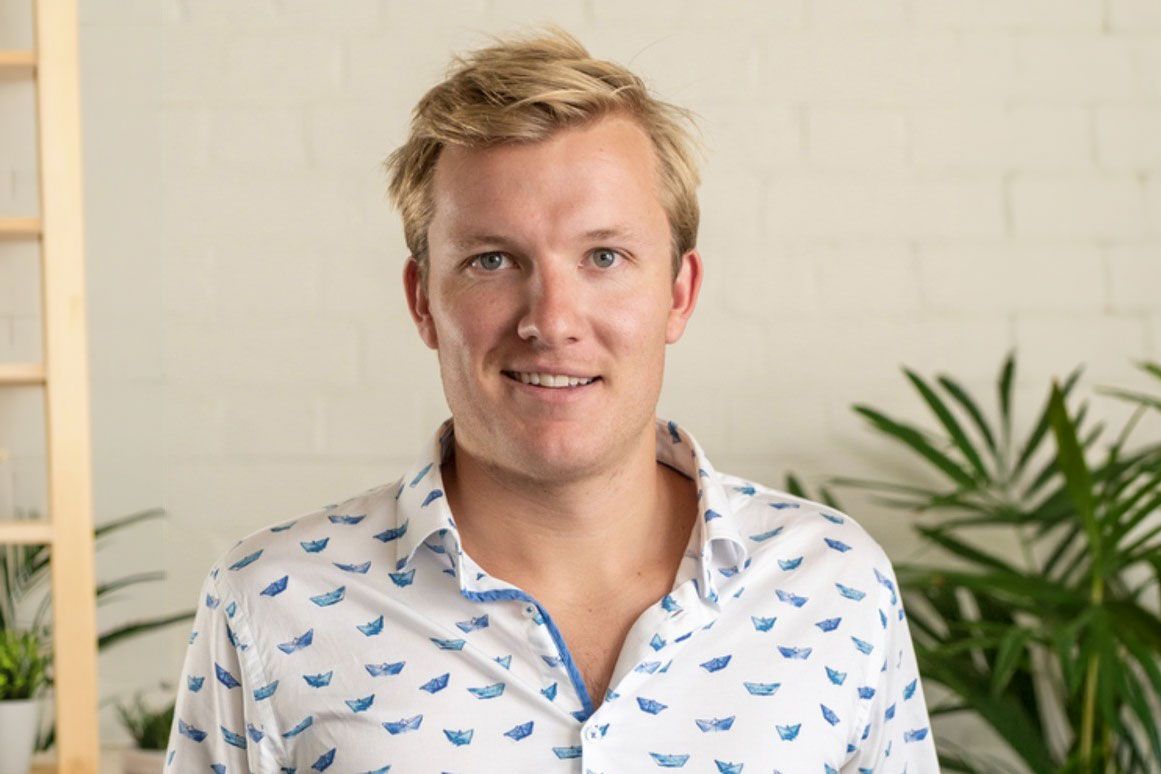
Aussie founder Mac Hepburn was watching his hard-earned dollars vanish into agency invoices, too scared to make his first hire. Then a mate mentioned a man that could turn it all around...
Staring at his to-do list, Mac felt his stomach sink. There it was again. Write the job ad. The same task he'd been putting off for months.
Mac runs Gorilla Reputation, an AI-first marketing business that helps landscapers win bigger jobs without burning cash on ads. Plus, he had two other startups on the side that cut into his hours.
Business was growing and clients wanted more. But one service was eating him alive. His SEO offering, the tricky work of getting businesses found on Google, wasn't done in-house at all.
He'd been working with local agencies, selling their work under his own name.
And it was a nightmare. Every change request went through a third party. Every client question meant another brief, another invoice, another agonising wait. Worst of all, Mac had no visibility into the very work he was putting his name on.
Deep down, he knew he needed a specialist inside the business, but he couldn't pull the trigger.
“I'd been putting it off because I thought it would be complicated or risky,” Mac admits.
In Australia, the average full-time salary now sits at $98,000 a year. Mac was bootstrapping his companies, so every dollar of that salary came straight out of what keeps the lights on.
If he was to hire, Mac knew a recruitment agency would also slug him a finder's fee of 15 to 25 per cent of that, just for making the introduction.
So the job ad just sat there, unwritten. That was, until a friend by chance mentioned a man, who could help.
The man who'd seen it all before
That man was Frank Kight.
Frank has spent more than a decade inside startups across Australia, New York, London and Europe. He was always right at the pressure points of growth: building commercial teams, cracking new markets, pushing sales.
The first startup was Streetbees, a London company whose app pays millions of ordinary people small amounts to share snapshots of their daily lives. Brands can then use these pictures to better understand how consumers behave.
Another was Choco, a Berlin startup that makes it easier for chefs to order ingredients with the tap of an app. It grew so fast that by 2022, investors valued it at more than a billion dollars.
These companies succeeded because they managed to get the right people in the right place to work on the right problem.
This is difficult for startups to achieve with the current systems of hiring.
The broken system
Recruitment is a slow process. The average Australian role now takes 44 days to fill, according to job site SEEK, and global HR firm Hays estimates 85% of organisations struggle to find the skills they need.
The obvious answer for founders is hiring overseas. But Frank saw what happened when founders turned to traditional outsourcing firms, and it wasn't pretty.
Layers of middlemen. Account managers wedged between the founder and the worker. A single monthly fee with zero breakdown of how much reached the person doing the job — and how much the agency pocketed.
In the worst cases, the startup didn't even know who at the agency was doing the work.
Frank also saw the human cost when it was done badly: remote workers treated as interchangeable labour, communication routed through go-betweens, expectations left vague, and quality left to chance.
So Frank and his co-founder Nick built Pear Tree to rip out those layers.
Pear Tree helps Australian startups hire experienced remote professionals from the Philippines and South Africa.
Rather than take a percentage from every month’s wage the way traditional outsourcing firms do, Pear Tree charges a one-time fee for finding the person.
After that, the relationship is direct. The client knows who they've hired, the employee knows who they work for, and the salary is transparent to both sides, just like any local hire.
“More of the budget should go to the talent,” Frank says. ”Less should be lost in the system.”
How they find the gems
A typical Pear Tree search draws 200 to 400 applicants per role.
Candidates are screened for strong written English and experience working with Australian startups.
Then Pear Tree conducts a test drawn from the job. A bookkeeper might be asked to sort transactions in Xero. A marketer might draft up an advert. Then come the one-on-one interviews.
Every placement is backed by a guarantee: if a hire doesn't work out within six months, Pear Tree finds a replacement at no charge.
The whole process runs two to three weeks, and Pear Tree has now made more than 750 placements and operates from six offices in Sydney, Auckland, Cebu, Manila, Cape Town and Hawke's Bay.
And if you're thinking “how could that work with time zones” – don't be. The Philippines runs zero to three hours behind Australia depending on the season. So an overseas team member works near the same scheduled block as the startup that hired them.
Keeping it all above board
While the benefits of overseas team members may be evident, making it happen is not always cut and dry.
In a case that rattled Aussie businesses, the Fair Work Commission ruled in 2024 that a paralegal working from her home in Manila for a Brisbane firm was an Australian employee under Australian law.
That is, she was not the 'independent contractor' her paperwork claimed – entitling her to protections like the minimum wage and unfair dismissal rights.
The lesson Frank reveals from this is that labels don't matter. How the working relationship operates does, and getting it wrong can be expensive.
Pear Tree says most clients pay talent through a monthly retainer, either straight from their bank account or through international money transfer, with payroll support available too.
For founders who would rather not wrestle with overseas contracts, payments and compliance themselves, Pear Tree also offers Employer of Record and Contractor of Record services.
In other words, it can handle the legal and administrative heavy lifting, while reducing the risk of a contractor arrangement coming back to bite them.
When Mac met Dianne
When Mac finally sat down with Pear Tree, Frank's team pushed him past the job title he'd sketched in his head and toward the shape of the work – the clients, the tools, and the deliverables he'd been buying from agencies at a premium.
Then they introduced him to Dianne: an SEO specialist in the Philippines with ten years of experience, at a monthly cost of $1,800.
That figure is roughly what some of Mac's agency invoices had covered for a fraction of the output. Yet in the Philippines, where living costs are far lower, it represents a strong professional salary.
Because Dianne wasn't hidden behind an account manager, Mac could message her directly, watch the work happen, and, for the first time, build SEO knowledge inside his own business instead of renting it.
When a client's needs shifted, there was no brief to write and no queue to join. Just a colleague who already understood the clients, the service, and where the company was headed.
“Once we got going, it just clicked,” Mac says. “I finally had someone in my corner who knew what they were doing, without the price tag that was holding me back.”
Four clients in seven days
In Dianne's very first week, Mac signed four new clients – all on recurring monthly retainers. For a startup, retainers are the difference between lumpy, unpredictable income and revenue you can plan around.
“That's not something I could have done on my own, and it wouldn't have happened without making that first hire,” he says.
Mac was no longer bottlenecked by an outside agency for every specialised task. He could see the work, understand the delivery, and say yes to new clients with total confidence that the business behind him could handle them.
The hire gave him more control, not less – the exact opposite of what most founders fear about hiring overseas.
More than cheap labour
Great global hiring finds an experienced person whose skills match the work, then creates the conditions for that person to become a trusted part of the business.
Pear Tree’s results speak for themselves: 90 per cent of Pear Tree’s placements remain in their roles, compared with an industry average of 60 per cent.
The client base now spans construction, technology, financial services and professional services.
Some clients are making their very first hire, like Mac. Others are expanding established teams without taking on the cost of a large local workforce. Most need capability before traditional hiring maths says they can afford it.
With Pear Tree, they can.
What the right person unlocks
Mac isn’t alone in looking beyond Australia for the skills his business needs.
Global hiring platform Deel recorded more than 1,400 cross-border hires by well-funded startups in 2025, with software developers accounting for 28 per cent of those appointments.
Broader research shows the trend is accelerating: 73 per cent of business and HR leaders expected more than half their new hires to be international by 2026.
Frank's years inside startups taught him that companies do not grow in straight lines. They make decisions with incomplete information, thin budgets and constant pressure to move and hiring will always carry some risk.
His mission is to strip out the unnecessary risks: opaque pricing, indirect relationships, and the artificial limit of hiring people who live nearby.
Because geography, he argues, shouldn't determine the calibre of person a company can hire.
A bootstrapped Aussie business that can't afford a senior specialist in Australia doesn't have to settle for a junior one, it needs to look somewhere else.
Mac’s still bootstrapping and still watching every dollar, but he's no longer trying to do everything himself.
One brave hire gave him the capacity to serve more clients, tighten his delivery, and start building a company that doesn't run on his hours alone.
And for Frank, that's the real measure of global talent done right. Not what a company saves, but what the right person lets it do next.
If a job ad has been sitting unwritten on your to-do list, it's time to have that first conversation. Book in a free consultation with Frank Kight.
