
A grain grader picks through a pile of lentils with tweezers, searching for broken pieces, weed seeds, dirt and gum nuts.
The sample is small enough to fit in a lunchbox, but the decision that follows can decide the fate of the entire truckload waiting outside. That’s a lot of pressure to place on one person’s judgement on a busy harvest day.
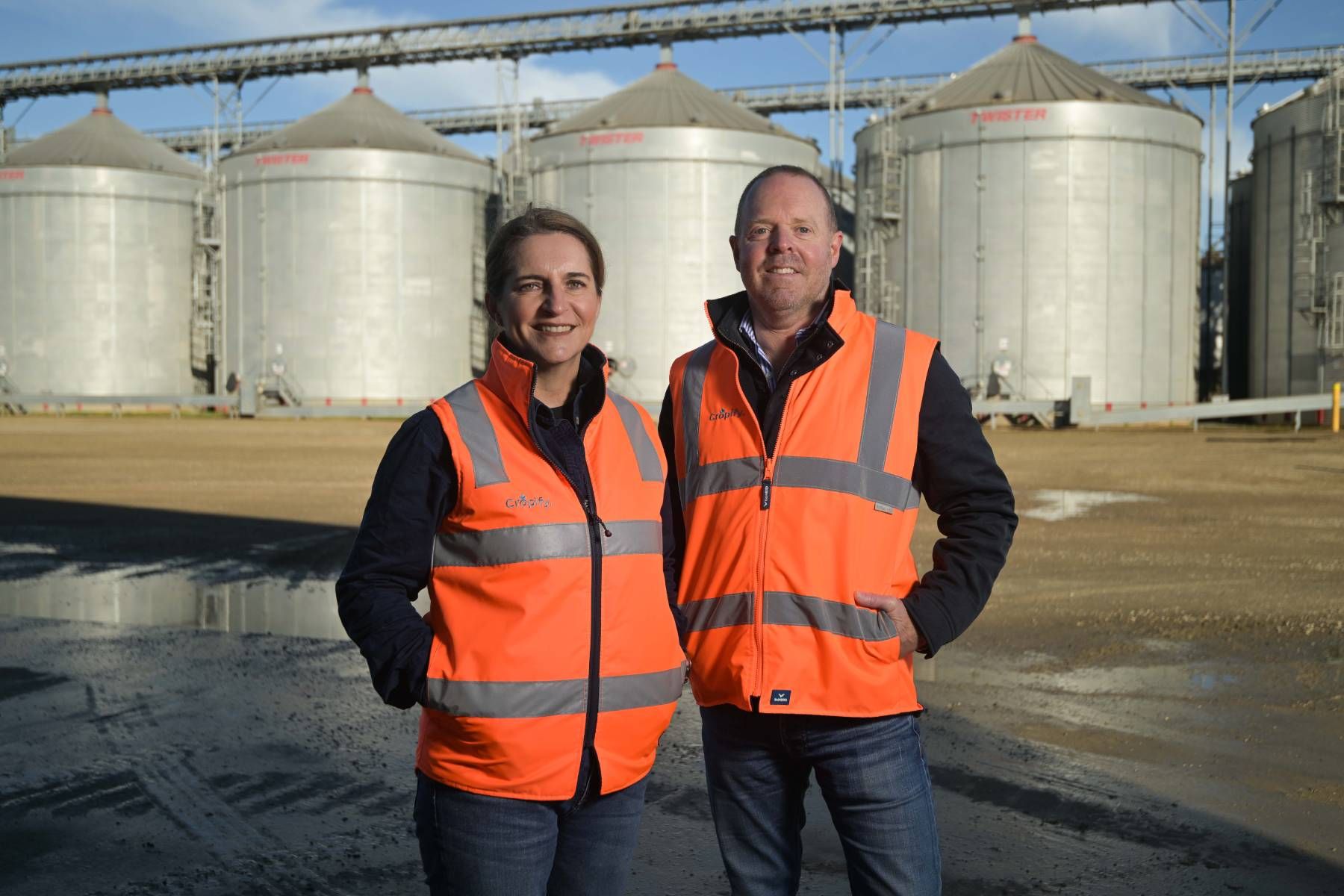
It's also the problem Adelaide founders Anna Falkiner and her husband Andrew Hannon set out to solve. Their startup Cropify uses AI-powered machines to issue accurate grain grades, every time.
Why grain must be graded
“The grain industry is massive,” Anna says. “It feeds the world.”
When Anna talks about grain, she’s referring to a whole swathe of dry crops: cereal grains such as wheat, barley and sorghum, pulses such as lentils, chickpeas and lupins, and oilseeds such as soybeans and canola.
Much of Australia's grain ends up in the Middle East and Asia, passing through traders, ports and storage silos along the way. But before the grain can do that, it must first be graded.
Grade one is the highest quality. If a sample has too many broken pieces or foreign materials, it can drop to grade two or grade three. That changes what the buyer pays, where the grain can be stored, and whether it can be exported at all.
Australia has strict standards for grain sold here, and other countries have their own for the grain they will accept. If Australian grain is being shipped to India, for example, it has to play by India’s import rulebook.
If a country does not allow a certain insect or seed across its border, the whole shipment can be turned away at the dock.
“So if any of that is present,” Anna says, “you won’t be able to export.”
The grade also affects what the grain can become. A family bag of lentils on a supermarket shelf has to look appetising for that night’s dal tadka, so grade one lentils with even colour are important.
A mill has different needs. If lentils are being ground into flour, broken pieces matter less because they’ll be crushed anyway. But the grain still has to be safe, clean and suitable for its final use.
“People think if it’s going to animal feed, it can be a lower grade, but it can’t,” Anna says. “Chickens have very sensitive stomachs; they like human-grade food.”
Where human judgement can go wrong
Anna says over half of all grain grading tests are still done by eye.
When the grade is right, the grain goes where it should: the right silo, port or country. When it is wrong, the mistake flows through the whole supply chain.
If a load of grain is graded too generously, say, a grade two load is incorrectly labelled as grade one, it can lower the value of every other load stored with it in the silo.
“Every time that parcel of grain moves, it changes, and must be retested,” says Anna.
The mistake can cut the other way too. A clean load can be judged too harshly and get pushed into a lower grade than it deserves.
When that happens, even though the grain could have met a higher standard, the grower is paid less. In Australia alone, $54 million is lost from misclassification every year.
“We’re taking away that subjectivity,” says Anna.
Visual grading also creates a labour problem. Grain grading takes skill, and that skill takes time to build. In regional areas, staff can already be hard to find, and during harvest, grain businesses need hundreds of trained people ready onsite.
Anna says a business might spend “two weeks minimum” training someone, only for that person to work one season and never return.
When the model met the paddock
Anna and Andrew knew the grain industry had relied on visual grading for decades. But they were convinced the industry could do better.
In 2019, they approached the Australian Institute for Machine Learning to prove that computers could identify grain defects from high-resolution images.
In a controlled setting, the model reached near 100% accuracy. But the real test would be whether the technology could work out in the field on a blustery October morning.
Cropify’s first idea was to use mobile phones to photograph the grain. But the team quickly found that different phones had different cameras, and the same sample could look different depending on the room and the light.
“We needed to have that controlled environment,” Anna says.
That decision changed the product. Cropify could not be software alone; the team also had to build hardware: a camera setup with reliable, repeatable conditions.
So Anna built boxes out of ceiling panels to test lights, cameras and lenses. She experimented with tray designs, trying to make each piece of grain sit flat enough for the camera to read.
“There were all these challenges that we had to address along the way,” she says.
Eventually, they had a prototype: a large hardware shell Anna describes as having “big spaghetti tubes coming out of the top of it”. It could take a sample, snap a picture, analyse it, and grade it in a fraction of the time a human could.
They put it in front of potential customers, and the warm response gave them confidence.
“Then we showed it to potential investors and they liked it as well,” says Anna. “So then we went, ‘okay, that's our go sign.’”
Industry knowledge gave Cropify an edge
Anna is a fifth-generation farmer. She once considered studying agricultural science, but chose business instead. She went on to work in product development and wine marketing before running her own consultancy.
Co-founder Andrew Hannon knew the grain industry from the inside. He worked as a farm manager, studied agribusiness, and later moved into senior grain roles with companies including GrainCorp and Viterra.
In those roles, he saw the grading problem up close: disputed grades, downgraded loads, repeated tests, and the constant work needed to train people to assess grain consistently.
Anna believes it is much harder to start with interesting technology and then search for a problem to solve. For her, the better path is to start with a problem you know deeply, then find the right technical people to help solve it.
“I think it’s much easier if you live and breathe the issue,” she says.
Anna thinks some competitors, particularly those who led with technology, have underestimated what happens on the ground.
“There’ve been some competitors who’ve tried to enter this space,” she says, “but they haven’t had the expertise in the industry or understood agriculture and the challenges.”
That knowledge also helped with customer research. In the early days, Anna and Andrew already knew people in the industry who were willing to talk and answer questions.
“You just have to talk to the potential customers,” Anna says. “You need to understand if it is a real pain point, and then get even more granular.”
Raising money for a problem investors had never seen
For years, Anna and Andrew funded Cropify’s early development themselves, with the occasional government grant for support.
As the product matured, fundraising became one of the hardest parts: not just finding money, but finding the energy and emotional resilience.
“So much of your time is spent trying to network and raise awareness with potential investors,” she says. “It takes a long, long time.”
If she had her time again, Anna says she would start the fundraising process a year earlier. Trying to explain grain logistics and harvest cycles to people who had not spent much time around agriculture was, Anna says, “really, really quite hard”.
For Anna, repetition helped. So did learning to separate the business conversation from her own sense of worth.
“Like anything in business, it’s not personal and it shouldn’t be personal,” she says.
Stone & Chalk helped Cropify leave the spare room
Anna had spent years working from a home office, but joining the Stone & Chalk Adelaide hub helped break that pattern.
“It got me out of my comfort zone with networking,” she says.
The hub gave her space to meet other founders, tap into engineers and software experts, and work through complex hardware problems.
It also gave Cropify a professional place to meet people while the company was growing.
The business became bigger than the founders
As the product improved, Cropify stopped being something only Anna and Andrew were carrying forward.
They now have a whole team which monitors where the product excels and where small changes can make a real difference for customers.
“I love seeing how passionate our team is about the product,” Anna says.
That’s one of the things she loves most about running the business.
“I very rarely feel like I don’t want to get out of bed and work,” she says. “What you put into it, you get out of it.”
Cropify brought its product to market in October 2025, and the company is now preparing for its next stage. But Anna is clear about what comes first.
Machine learning, it turns out, is not cheap or quick to build — and it demands a lot of skilled people to keep improving. So rather than racing to expand, Cropify is focused on consolidating its position in Australia first.
That involves getting more machines into the hands of grain handlers, deepening relationships with early customers, and continuing to train its models across different grains and harsher conditions.
What Anna would do differently
Anna's first piece of advice is to know the market before you build for it.
“Make sure you spend adequate time researching what the actual market is,” she says. “Check it, check it again, and then get someone else to check it.”
She also encourages founders to build realistic numbers, with room for delays and extra costs.
“Be a pessimist when you're doing your figures,” says Anna. “If you can, underpromise and overdeliver.”
She also warns founders not to get too fixated on startup scorecards: how many investors they have, how much they have raised, or whether they are chasing unicorn status.
“Just go about it wanting to build a profitable solid business and a great place to work,” she says.
A company built from a pile of grain
Every grain shipment that leaves an Australian port has been graded by someone.
For most of the industry's history, that someone has been a grader with a pair of tweezers and a trained eye – making judgment calls worth millions, in conditions never designed for consistency.
Anna Falkiner and Andrew Hannon have spent years building technology to make grain grading more reliable. And with overseas scaling on the near horizon, their work so far is just a small sample of much bigger things to come.
